
What is the standard warranty period for the power plant boiler and its critical components?
Warranty disputes on power plant boilers tend to surface at the worst possible moment — six months into operation, when a superheater coil cracks or a feedwater pump seizes, and suddenly nobody can agree whether the clock started at factory shipment or site commissioning. That ambiguity alone has stranded plants in unplanned outages for weeks while procurement teams dig through contract language. The financial exposure is real: pressure-part repairs on a mid-size utility boiler can run well into six figures once you factor in emergency fabrication, certified welders, and lost generation revenue.
The standard warranty period for a power plant boiler is typically 12–18 months from commissioning or 18–24 months from delivery, whichever comes first — this is the norm across most Chinese and international OEMs. Critical pressure parts such as drums, headers, waterwalls, and superheater coils commonly carry 18–24 months, and EPC contracts sometimes extend weld-integrity coverage to 36 months. Auxiliary equipment — fans, pumps, economizers, burners — generally follows a 12-month commissioning-based term governed by sub-supplier agreements.
What most procurement managers miss, though, is that these ranges are not fixed — they shift depending on contract structure, fuel type, operating pressure, and whether the scope is a supply-only order or a full EPC turnkey package. Knowing which variables to negotiate before you sign is where the real protection lives.
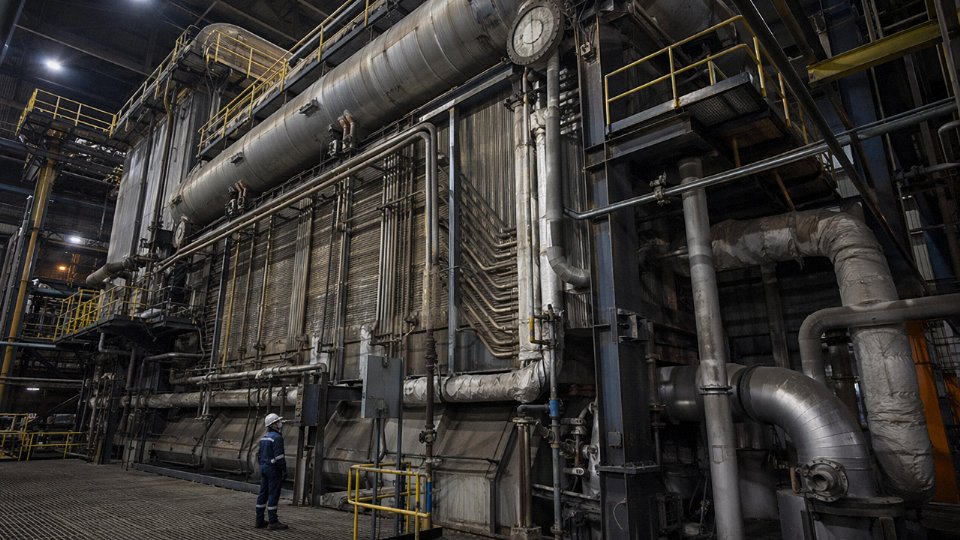
Industry-Standard Warranty Periods: Whole-Unit Boiler Coverage from Commissioning to Expiry
The first question any experienced procurement engineer asks after the technical spec is locked: when does the warranty clock actually start, and what stops it? These two details alone can shift your effective coverage window by six months or more — and on a 50 MW power plant boiler, that gap is not academic.
The Two Clock-Start Triggers — and the Gap Between Them
Most boiler supply contracts define one of two trigger events. The first is mechanical completion and first fire (sometimes called provisional acceptance), which is typically declared when the boiler has passed hydraulic pressure testing, all interlocks are functional, and the unit has achieved stable combustion for a defined period — often 72 consecutive hours at rated load. The second trigger is final acceptance after performance testing, which follows a full-load efficiency run, emission compliance verification, and sign-off by the owner’s engineer.
On a small industrial package boiler (say, 10–20 t/h), the gap between those two events might be three or four weeks. On a subcritical utility boiler above 200 t/h, with a full performance guarantee test requiring specific coal quality and grid stability, that gap routinely runs 3 to 9 months — sometimes longer if the plant’s grid connection is delayed or if fuel supply isn’t stable enough to sustain a valid test run. The manufacturer’s warranty language defines which event starts the clock. That distinction is worth reading twice before you sign anything.
Whole-Unit Warranty Benchmarks by Boiler Class
The table below reflects actual commercial practice, not best-case marketing claims. Figures vary based on contract structure, boiler pressure class, and whether the scope is supply-only or full EPC.
| Boiler Type / Context | Typical Whole-Unit Warranty Duration | Clock-Start Reference |
|---|---|---|
| Industrial boilers, 10–75 t/h (steam or hot water) | 12–18 months | From commissioning / first stable operation |
| Utility / power-station boilers, >75 t/h, subcritical | 18–24 months | From provisional or final acceptance |
| Supercritical / ultra-supercritical units | 24 months (some EPC contracts: 36 months for pressure parts) | From final acceptance |
| EPC turnkey contracts (FIDIC or Chinese standard) | 24 months from provisional acceptance, or 12 months from final acceptance | Whichever clause the contract specifies |
| Chinese national standard baseline (GB 150 / NB/T 47004 framework) | 12 months from acceptance | From owner’s written acceptance |
The Dual-Trigger Clause — and Why Buyers Consistently Lose on It
The most common warranty language in Chinese OEM contracts reads something like: “18 months from date of delivery, or 12 months from commissioning, whichever is earlier.” Manufacturers favor this structure for an obvious reason — if your commissioning is delayed by civil works or grid connection issues, the clock erodes against you regardless. Buyers should push hard to change that final phrase to “whichever is later.” It’s a small edit with real consequences. In practice, getting a Chinese boiler manufacturer to accept that revision is possible, especially on larger EPC contracts, but expect pushback and expect to trade something else to get it.
Force Majeure, Grid Curtailment, and Warranty Tolling
Unplanned shutdowns do happen — grid curtailment, fuel unavailability, owner-directed idle periods. Under FIDIC Silver Book and Chinese standard EPC contract frameworks, these events can toll (pause) the warranty clock, but only if properly documented and notified in writing within a specified window (commonly 14–28 days of the event). If your plant sits idle for three months because coal supply was interrupted and you didn’t issue a formal tolling notice to the contractor, you’ve likely lost those three months of coverage. The mechanism exists; it just requires discipline to invoke.
Mandatory Quality Guarantees Under TSG G0001
Separate from any commercial warranty negotiation, boiler pressure vessel components manufactured and registered in China are governed by TSG G0001 (Boiler Safety Technical Supervision Regulation). This regulation imposes mandatory quality and traceability obligations on pressure parts — drums, headers, downcomers, waterwall panels — that exist independent of whatever the commercial contract says. Think of it as a regulatory floor beneath the negotiated warranty. It doesn’t extend the warranty period per se, but it does mean that documented manufacturing defects in pressure parts carry a legal quality liability that can’t simply be waived by a short commercial warranty clause.
The dual-trigger warranty clause 'whichever is earlier' is standard practice among most Chinese boiler OEMs and systematically reduces effective buyer coverage when commissioning is delayed.True
This clause structure is widely documented in Chinese boiler supply contracts and is a known procurement risk flagged by EPC contractors operating under FIDIC and Chinese standard contract frameworks. Buyers with delayed commissioning timelines consistently find their warranty period has partly expired before meaningful operation begins.
Component-by-Component Warranty Breakdown: Pressure Parts, Rotating Equipment, and Control Systems
Contract warranty clauses are rarely written with uniform coverage across every boiler subsystem — and if your procurement team is treating them that way, you’re leaving serious risk on the table. Different components fail by fundamentally different mechanisms, so their warranty durations reflect those realities, not arbitrary OEM generosity.
Pressure-Retaining Parts: Drums, Headers, Waterwalls, and Coil Bundles
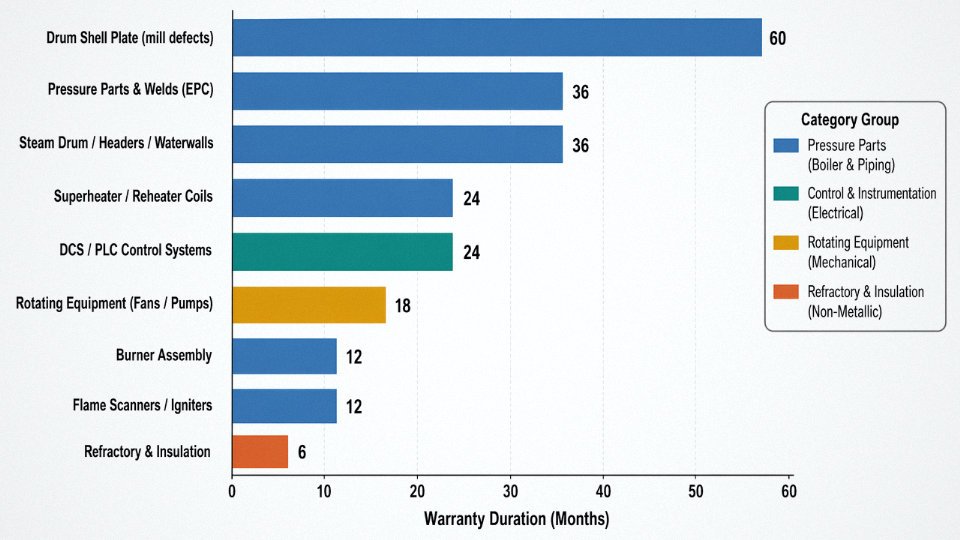
This is where the money is, and most experienced EPC engineers spend the most time negotiating. Steam drums, mud drums, downcomers, headers, and waterwall panels typically carry 18–24 months of warranty from commissioning. In contracts where weld integrity is explicitly called out — and it should be — 24 months is the practical floor. Some premium contracts, particularly for utility-scale or CFB boilers with complex membrane waterwall assemblies, push weld guarantees to 36 months.
Drum shell plate manufacturing defects are a different matter. If your OEM is supplying SA-299 or equivalent heavy-plate drums, some manufacturers will offer 5-year coverage against plate lamination or mill-origin defects specifically — this is more common in premium-tier contracts than people assume, and worth asking for in writing.
Superheater, reheater, and economizer coil bundles follow pressure-part rules broadly, but erosion from fly ash or fuel impurities is almost always carved out. Get that exclusion language defined precisely. “Erosion” and “material defect” are not the same failure mode, and a contested failure at month 20 will cost you more in downtime and legal fees than the repair itself.
Refractory and Insulation: The Shortest Warranty Window
Expect 6–12 months, and don’t be surprised when a vendor quotes 6. Furnace lining, cyclone separator refractory in CFB boilers, door seals — all of these suffer thermal cycling fatigue that genuinely begins on Day 1 of operation. Asking for 18 months on refractory is reasonable as a negotiating position, but the distinction between a material defect (covered) and normal thermal spalling or erosion wear (not covered) has to be documented during the factory acceptance test and at first commissioning inspection. Photograph everything.
Rotating Auxiliary Equipment: Fans, Pumps, and Mechanical Seals
Induced-draft fans, forced-draft fans, primary air fans, feedwater pumps, condensate pumps, and circulating pumps in hot-water or thermal-oil systems typically get 12 months from commissioning — usually a pass-through of whatever the sub-supplier offers. That matters because if your FD fan is sourced from a regional manufacturer, their standard terms may only cover bearings and mechanical seals for 6 months. Check the sub-supplier documentation, not just the main contract schedule. In practice, mechanical seal failures on feedwater pumps around the 8–10 month mark are common enough that keeping a spare seal set on-site from the start is just good maintenance hygiene.
Burner Assemblies: Whole-Unit vs. Consumable-Adjacent Components
For gas-fired, oil-fired, or dual-fuel boilers, the burner assembly as a whole typically carries 12 months. But igniter electrodes, flame scanners, and nozzle tips are treated as consumable-adjacent — 6 months is standard, sometimes less depending on fuel quality and firing cycles. If your boiler uses Weishaupt, Riello, or Baltur sub-supplied burners, those OEM terms govern, and the boiler manufacturer is essentially acting as a pass-through. Make sure the actual sub-supplier warranty certificates are handed over at delivery, not just referenced in a schedule.
Burner flame scanner warranty is typically shorter than the main boiler warranty.True
Flame scanners and igniter electrodes are classified as consumable-adjacent components by most OEMs and sub-suppliers; 6-month coverage is standard industry practice, compared to 12 months for the burner assembly as a whole.
DCS/PLC Control Systems and Instrumentation
Pressure transmitters, thermocouples, flow meters, safety interlocks — 12–18 months from commissioning is the norm. Software bugs and control logic errors, however, are usually warranted for correction up to 24 months post-commissioning, even when the hardware warranty has lapsed. That distinction matters when a trip sequence misbehaves at month 19. Cybersecurity patch obligations are showing up in modern EPC contracts now, particularly for systems integrated with plant SCADA networks — it’s still inconsistently applied, but worth including as an explicit clause.
Heat Recovery and Flue-Gas Treatment Auxiliaries
Economizers and air preheaters: 12–18 months, aligned with main unit terms. SCR and SNCR DeNOx systems follow similar calendar-based coverage, but the catalyst itself is warranted separately by operating hours — typically 16,000–24,000 hours, depending on flue-gas composition and the presence of catalyst poisons like arsenic or alkali compounds. That number can drop significantly with poor fuel consistency. ESP and baghouse filter bags are consumables; bag life is guaranteed against manufacturing defects for a defined period but not against premature blinding from process upsets.
Thermal-Oil Heaters: One Critical Carve-Out
The coil or serpentine tube bundle in a thermal-oil heater follows standard pressure-part warranty rules — 18–24 months from commissioning. The thermal-oil fluid itself is entirely the buyer’s responsibility. Fluid degradation, carbon fouling of tubes from overheated fluid, and viscosity changes are not OEM warranty items. Buyers occasionally push back on tube fouling claims only to find the root cause was inadequate fluid management or operating above the fluid’s rated bulk temperature. Run periodic fluid analysis; don’t assume the boiler OEM will cover consequences of fluid neglect.
| Component Category | Typical Warranty Duration | Key Dependencies / Exclusions |
|---|---|---|
| Pressure parts (drum, headers, waterwalls) | 18–24 months from commissioning | Weld integrity often 24–36 months; erosion excluded |
| Drum shell plate (manufacturing defect) | Up to 60 months in premium contracts | Plate lamination/mill defects only |
| Refractory and insulation | 6–12 months | Material defect only; thermal wear excluded |
| Rotating auxiliary equipment | 12 months; bearings/seals 6 months | Sub-supplier pass-through terms apply |
| Burner assemblies | 12 months (whole unit) | Electrodes, scanners, nozzle tips: 6 months |
| DCS/PLC hardware | 12–18 months | Software/logic corrections: up to 24 months |
| SCR catalyst | 16,000–24,000 operating hours | Fuel quality and catalyst poisons affect actual life |
| Thermal-oil coil bundle | 18–24 months | Fluid degradation: buyer’s responsibility |
How Boiler Type and Fuel Determine Warranty Scope and Exclusion Clauses
A boiler warranty is not a blanket guarantee. The technology type, the fuel chemistry, and the operating conditions at your specific site all shape what the OEM will — and will not — stand behind. Missing this in contract review is how plant owners end up absorbing a six-figure repair bill that they genuinely believed was covered.
CFB Boilers: Erosion Is the Dominant Exclusion
Circulating fluidized bed boilers are mechanically aggressive environments. Cyclone refractory linings and bed material contact surfaces wear continuously, and virtually every reputable OEM excludes refractory erosion from warranty coverage after an initial 6-month break-in period — sometimes shorter if the plant runs high-sulfur coal or anthracite fines with irregular particle sizing. Loop seals and U-beam erosion shields typically carry a 12-month warranty, but that window closes fast if fuel specification is breached.
The fuel spec clause is the one most procurement managers underestimate. If your contract specifies a fuel with particle size d50 of 6–8 mm and ash abrasivity index (BAI) below a defined threshold, and the plant starts burning a coarser, harder fuel from a different mine or season, the OEM’s position becomes legally defensible and your erosion claim disappears. Fuel analysis records — weekly or at minimum per-delivery — are not optional paperwork. They are your warranty evidence.
[Biomass Boilers](https://coalbiomassboiler.com/product/biomass-boilers/): Chlorine and Alkali Tolerances Define Coverage
Straw, rice husk, palm kernel shell, bagasse, and wood chips all carry varying levels of chlorine and alkali metals (potassium, sodium). Superheater corrosion driven by chlorine-induced high-temperature attack is a well-understood failure mode, and OEMs price that risk into the exclusions. Contracts for biomass boilers should include explicit fuel tolerance bands — typically Cl below 0.3% and combined K+Na below roughly 0.2 kg/GJ — and corrosion damage is excluded if fuel analysis logs show exceedances. Grate bars and stoker components are treated as wear items: expect 6–12 months coverage, and budget for replacements as a normal operating cost rather than a warranty recovery.
MSW Incinerators: Tube Wall Loss Rates and Grate Hours
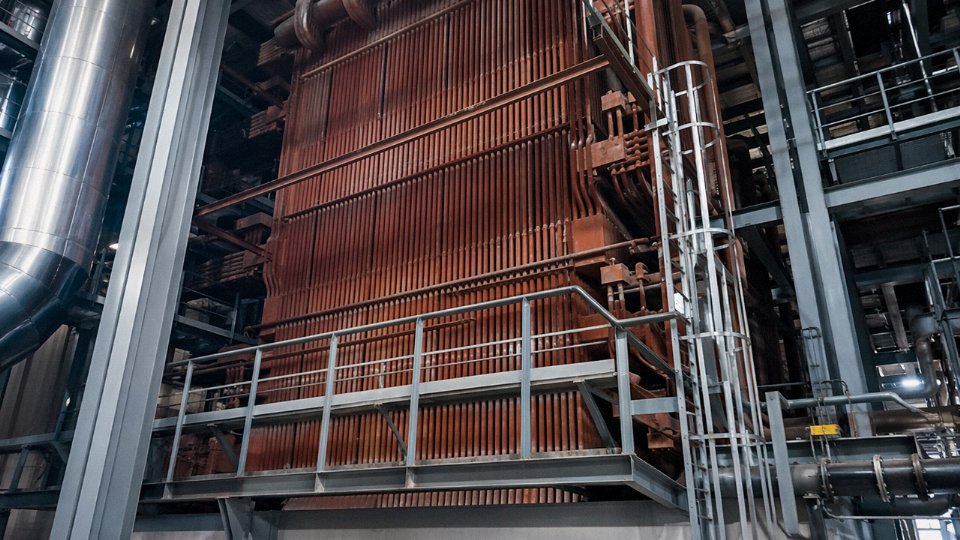
Municipal solid waste is chemically hostile in ways that coal and gas simply are not. Waterwall tube corrosion warranties in MSW boilers are heavily qualified — the standard OEM position is that tube wall thickness reduction will not exceed roughly 1.5 mm/year provided the waste feed meets the specified lower heating value and chlorine concentration. Step outside those bounds and the corrosion warranty becomes unenforceable. Reciprocating grate segments are typically warranted for 8,000–12,000 operating hours or 12 months, whichever comes first, and in practice a well-run MSW plant consuming mixed municipal waste will often hit that hour threshold before the calendar year is out.
Waste-Heat Recovery Boilers: GT and Process Derating Voids Tube Warranties
HRSGs behind gas turbines, reciprocating engines, or industrial kilns are passive heat exchangers in one sense, but the warranty conditions are anything but passive. Inlet gas temperature, mass flow, and composition must stay within ±5% of the design specification or the OEM’s tube bundle warranty is void. This matters enormously in plants where the upstream process is variable — a kiln firing different clinker mixes, or a gas turbine that gets derated seasonally or switched to a lower-Wobbe fuel. The HRSG manufacturer has no control over what the GT operator does, and contracts reflect that hard reality.
HRSG tube bundle warranties are void if the upstream gas turbine is derated or fuel-switched without OEM notificationTrue
OEM warranty on tube bundles is conditioned on inlet gas parameters staying within the agreed design envelope; any deviation that changes thermal flux distribution or dew point shifts the risk to the plant operator, which is standard practice across major HRSG suppliers.
Hot-Water Boilers: Water Quality Is the Warranty Condition
District heating and process hot-water boilers look straightforward but carry one underappreciated warranty condition: water treatment compliance. Most OEM contracts reference GB/T 1576 or equivalent — dissolved oxygen below 0.1 mg/L, pH in the 8.5–9.5 range, hardness under about 0.03 mmol/L. Scale buildup and pitting corrosion are excluded if the plant cannot produce continuous water quality logs. In practice, plants that run their own chemical dosing systems without a calibrated online analyzer are the ones that lose this argument. The OEM will ask for records, and “we dosed regularly” is not a record.
Thermal-Oil Heaters: Coking Is an Operator Problem
Thermal-oil (heat transfer fluid) heaters operate at bulk fluid temperatures typically between 280–340 °C depending on design, and the dominant failure mode is coking — carbon deposition on tube walls caused by fluid overheating, usually from localized hot spots when flow is insufficient or fluid has degraded past its service limit. OEMs universally exclude coking and tube fouling from warranty. The standard condition is that the high-temperature cutout system is functional and calibrated, and that fluid analysis (acid number, flash point, viscosity) is performed at least annually. Without those maintenance records, any coking-related tube failure is the plant’s cost to carry.
Gas- and Oil-Fired Package Boilers: NOx Guarantees Are Fuel-Specific
Performance warranties on gas- and oil-fired package boilers — particularly NOx emission guarantees in the 60–100 mg/Nm³ range at 3% O₂ — are written against a specific fuel: defined LHV, Wobbe index, and for oil, viscosity and sulfur content. Switching from pipeline natural gas to LPG, biogas, or a different crude-derived fuel oil without OEM approval voids both the emission warranty and, frequently, the thermal efficiency guarantee. This comes up more often than it should in plants that switch fuels opportunistically based on price. The contractual exposure is real: if an emission compliance test fails after an undisclosed fuel switch, the OEM has grounds to disclaim the entire performance section of the contract.
The consistent pattern across all these boiler types is that OEM warranties are conditional contracts, not unconditional guarantees. The conditions are fuel composition, water or fluid quality, and process stability. Document all three from day one.
What Voids a Boiler Warranty: Operational, Maintenance, and Installation Red Lines
Most warranty disputes don’t start with a manufacturing defect. They start with a plant operator pushing the unit harder than the design allows, or a maintenance crew skipping a quarterly task because the shutdown window was tight. Understanding exactly where the red lines are — before you cross them — is the difference between a covered repair and a six-figure out-of-pocket replacement.
Operating Outside the Design Envelope
This is where pressure-part warranties die fastest. Sustained steam pressure above MAWP by more than roughly 3%, steam temperature creeping more than 10°C over design (common during peak-load chasing on coal-fired units), or chronic operation below minimum continuous rating — all of these shift liability squarely onto the operator. MCR floor is typically 30–40% for coal and biomass-fired boilers, around 25% for gas-fired units, though the exact figure depends on burner design and circulation ratio. Modern DCS systems log this continuously, and OEM warranty engineers will pull that data during a claim investigation. They will find the excursions.
The practical trap here is drum-level hunting during load swings. Operators trying to hold steady output through a variable fuel quality period sometimes drive steam temperature high without realizing it. A 15°C overshoot for four hours doesn’t feel catastrophic at the time. Six months later, when a superheater header shows creep cracking, it absolutely matters.
Unauthorized Modifications to Pressure Parts
Any welding, cutting, nozzle addition, or structural attachment to a pressure component — drum, header, waterwall panel, superheater coil — without written OEM approval voids pressure-part warranty immediately. This seems obvious, but field modifications happen more often than anyone admits, usually during an emergency outage when the OEM’s approval process feels too slow.
The same logic applies to auxiliary components. Swapping a specified 16Mn alloy fan impeller for a standard carbon steel substitute in a high-dust application (say, a CFB with high-ash coal or a biomass boiler running rice husk) is a documented warranty exclusion trigger. The OEM specified that material for a reason — erosion resistance, typically — and if the replacement fails, the sub-supplier’s warranty is void and so is any claim upstream.
Feedwater and Boiler Water Chemistry Violations
In practice, this is the single most contested area in boiler warranty disputes. OEMs require a continuous IWC log demonstrating compliance with GB/T 1576 (for Chinese-supplied units) or relevant ASME guidelines on feedwater quality — dissolved oxygen, pH, hardness, silica, iron content. Even one logged excursion above O2 or hardness limits, captured in the DCS historian, can shift liability for tube failures entirely to the operator. Courts and arbitration panels have consistently sided with OEMs when the chemistry records show non-compliance.
Start the water treatment program before first fill, not after commissioning. This is not a bureaucratic formality.
Missed Mandatory Maintenance Intervals
Annual safety valve testing, monthly blowdown procedures, semi-annual refractory inspection, fan bearing lubrication on the OEM-specified cycle — these are contractual obligations, not suggestions. The O&M manual defines them precisely, and the warranty clause typically references that manual by document number. A missed refractory inspection that precedes a furnace wall failure will be scrutinized. Gaps in the maintenance log are interpreted as gaps in the maintenance itself.
Commissioning by Uncertified Personnel
Chinese regulations under the TSG framework require boiler installation and commissioning to be supervised by a licensed installation unit. For overseas projects, local authority inspection requirements apply, and any deviation from the OEM-approved commissioning procedure — skipping a hydrostatic hold period, bypassing a pre-commission chemical clean — creates warranty exposure that can be difficult to close later.
Physical Damage and Documentation Gaps
External events — flooding, lightning, seismic damage, foreign object ingestion into fans or feedwater systems — are excluded from virtually every boiler warranty. The answer here is insurance riders, not extended warranty negotiation. These are insurable risks; treat them that way.
Documentation is where valid claims collapse. Serial numbers, commissioning reports, operating logs, water treatment records, maintenance checklists: all of it needs to be intact and retrievable. Missing records are the primary rejection reason for otherwise legitimate warranty claims. A digital O&M logbook system, implemented from day one of commissioning, costs almost nothing relative to the risk of a disputed claim on a pressure vessel.
A single documented water chemistry excursion in the DCS log can void a boiler pressure-part warranty claim, even if the excursion was brief.True
OEM warranty clauses typically reference compliance with GB/T 1576 or equivalent standards as a condition of coverage. DCS logs are admissible evidence in warranty disputes, and even a short excursion above dissolved oxygen or hardness limits provides the OEM grounds to reject liability for tube or drum failures.
Negotiating Stronger Warranty Terms: Leverage Points for EPC Contractors and Plant Owners
If you’ve sat through enough boiler contract reviews, you know the warranty clause is where the real negotiation happens — and where inexperienced buyers quietly lose thousands, sometimes millions, in post-commissioning exposure. The default terms any OEM sends in a first draft are written to protect the OEM. Your job is to push back intelligently, with specific language, not vague requests for “better coverage.”
Start the Clock at Final Performance Acceptance, Not Delivery
On overseas projects — and this is especially relevant for buyers in Southeast Asia, Africa, or the Middle East taking delivery from Chinese or European manufacturers — equipment can sit in a container, a bonded warehouse, or an unfinished civil structure for anywhere from 6 to 9 months before it ever sees steam. Agreeing to a warranty triggered by ex-works or even FOB delivery date is effectively giving away 6–9 months of your coverage before a single valve has been operated.
Insist on commissioning date or final performance acceptance date as the clock-start. The latter is stronger: it means the unit has passed its performance test — steam output, efficiency, emissions — and the warranty period begins only then. Most reputable OEMs will accept this, especially if you’re signing an EPC-scope contract. If a manufacturer refuses outright, that’s actually useful information about how they view post-sale obligations.
The Defect Notification Period Is Not Optional
FIDIC-based EPC contracts (Silver Book, in particular) include a defect notification period — typically 28 days, though buyers can and should push for 60 to 90 days — that runs after warranty expiry. During the DNP, the buyer can still formally notify the contractor of defects that existed within the warranty window but were only discovered afterward. Latent weld cracks in a superheater header, for instance, may take 14–18 months of thermal cycling to manifest visibly.
Without a DNP clause, a defect that developed at month 11 of an 12-month warranty but shows up at month 13 is simply your problem. With it, you still have recourse. Procurement managers reading boilerplate sub-contracts should check whether this clause even exists — it’s frequently missing.
Extended Coverage on Long-Lead Pressure Parts Is Negotiable
Steam drums, superheater headers, and waterwall panels are not cheap, and weld-related failures in these components are almost always latent — the damage accumulates before the crack propagates. Standard 12-month coverage on these items is, frankly, inadequate given their replacement cost and lead time (typically 16–28 weeks for a drum, depending on plate thickness and mill scheduling).
Pushing for 36-month warranty on pressure-part weld seams and base material is realistic with any OEM that has genuine confidence in their fabrication quality. Some EPC contracts I’ve reviewed in power and industrial cogeneration projects specify this explicitly, with third-party NDT reports as supporting documentation. If the manufacturer balks, ask why — the answer is revealing.
Warranty Bond and Retention: Financial Skin in the Game
A warranty bond — typically 5% to 10% of contract value, held as a bank guarantee — is standard practice in well-structured EPC contracts. For overseas buyers working with a manufacturer for the first time, it’s essentially non-negotiable. Without it, your only leverage after commissioning is litigation across international jurisdictions, which is slow and expensive.
The bond should release in tranches: roughly half at end of warranty, the remainder after the DNP closes cleanly. Tying final release to demonstrated availability — say, ≥8,200 operating hours in the first year of commercial operation — and verified thermal efficiency (≥88% on bituminous coal at MCR, or ≥85% on biomass, depending on fuel spec) gives you a measurable, defensible release condition rather than a calendar date the OEM’s sales team is counting down to.
Back-to-back warranty pass-through from EPC contractor to plant owner is standard industry practiceTrue
Under FIDIC and most international EPC frameworks, sub-supplier warranties for fans, pumps, burners, and control systems should be formally assigned to the end client. In practice, this assignment is routinely omitted in boilerplate sub-contracts and must be explicitly required by the plant owner during contract negotiation.
Response Time SLAs: Make “Prompt Response” Unenforceable Language Disappear
“The supplier shall respond promptly to warranty claims.” That sentence means nothing and will not survive a dispute. Replace it with specific, tiered SLAs: safety-related failures (pressure boundary breach, control system failure causing trip) get a remote technical response within 24 hours; a qualified service engineer on-site within 72 hours for international projects; spare parts for common failure modes dispatched within 5 business days from the OEM’s warehouse or regional hub.
In practice, the 72-hour international SLA is the hardest to enforce and the most worth fighting for. An OEM with no regional service presence will struggle to meet it — and knowing that upfront helps you decide whether to require them to pre-position a spare parts kit locally as a contract condition.
Back-to-Back Pass-Through for EPC Contractors
If you’re the EPC contractor rather than the end owner, do not retain sub-supplier warranties in your own name. Assign them formally to the plant owner through a written novation or assignment clause in each sub-contract. Fans, feedwater pumps, burners, DCS systems — each carries its own OEM warranty, usually 12 months from commissioning governed by the sub-supplier’s standard terms. The plant owner needs direct recourse to those sub-suppliers, especially after your EPC contract closes out. This is one of those details that gets skipped in the rush to close procurement, and it costs owners real money when a Siemens actuator or a GD fan bearing fails at month 14.
Taishan Group Boiler Warranty Framework: What Overseas EPC and Direct-Supply Clients Receive
Taishan Group’s standard commercial warranty runs 18 months from commissioning or 24 months from delivery, whichever comes later — not whichever comes first. That distinction matters more than it might seem. Most OEMs write “whichever comes first” into their contracts, which effectively punishes a buyer for any delay in commissioning. If your project sits at port for six weeks, or civil works run long, or grid connection is held up by the utility, you’ve already burned through part of your coverage before the boiler has fired a single tonne of coal. Taishan’s clock-start logic was deliberately written the other way, and in practice it gives overseas EPC projects a meaningful buffer — typically an extra two to four months of real coverage on projects where first firing slips past the originally planned date.
This warranty structure applies across the full product range: coal-fired industrial boilers from 4 t/h up to 130 t/h, CFB boilers from 35 t/h through 480 t/h (where the refractory and cyclone wear surfaces carry their own documented scope), biomass-fired boilers from 4 to 130 t/h, oil and gas package boilers from 1 to 50 t/h, thermal-oil heaters from 350 kW to 14 MW, hot-water boilers from 0.7 to 29 MW, custom waste-heat recovery boilers, and MSW incineration boilers. Each product line has its own warranty documentation rather than a single blanket sheet — relevant because the exclusion clauses for a thermal-oil heater (coking thresholds, fluid degradation boundaries) look nothing like those for a CFB unit burning high-ash Indonesian subbituminous coal.
Manufacturing Qualifications That Actually Back the Warranty
A warranty is only as solid as the manufacturer’s ability to make good on it. Taishan holds ASME S and U stamp certification, which matters for North American supply and, more broadly, signals that the pressure vessel fabrication program is subject to Authorized Inspector oversight — not just internal QC. CE/PED marking covers EU-destined projects. The ISO 9001:2015 QMS is in place, and — more operationally relevant — all pressure welds go through third-party NDT using RT and UT per NB/T 47013 before shipment. On the extended warranty option (see below), 100% RT on drum welds plus hydrostatic test at 1.5× MAWP is included as a standard protocol, not an upcharge add-on.
The Class A TSG manufacturing license under China’s boiler safety technical supervision framework is the domestic baseline, but the combination of ASME and CE credentials is what tends to satisfy plant owners and insurance underwriters in Southeast Asia, the Middle East, and Sub-Saharan Africa, where project financing often requires third-party-certified pressure vessel documentation.
Extended Coverage and Post-Warranty Service Structure
The standard 18/24-month term is extendable to 36 months on pressure parts — drums, headers, waterwalls, superheater coils — under an enhanced quality inspection protocol. For high-pressure CFB projects above 9.8 MPa, or for projects with aggressive fuel chemistry (high-chlorine biomass, municipal solid waste with variable calorific value), extending to 36 months is genuinely worth the additional cost, because pressure-part failures in that window are almost always weld or material related rather than operational wear.
Post-warranty annual service contracts cover water chemistry advisory (often the most overlooked factor in pressure-part longevity), tube-thickness UT surveys, and performance efficiency testing. In practice, plants that skip the water chemistry advisory tend to see oxygen pitting or caustic embrittlement claims that fall outside the warranty period and are entirely avoidable.
Overseas Warranty Support: Response Times and Sub-Supplier Back-to-Back Coverage
For overseas projects, spare-parts depots are positioned regionally, and service engineer dispatch from China to Southeast Asia or the Middle East runs within roughly 72 hours of a confirmed warranty claim — dependent on visa processing, which is the one variable outside Taishan’s direct control. For Africa and South America the window stretches to 96–120 hours in most cases. The local service partner network currently covers 30+ countries, meaning in-country support is usually available for initial fault assessment while travel is arranged.
Remote DCS monitoring is available on projects with stable internet connectivity — this is not a selling point so much as a practical diagnostic tool that has, in several instances, allowed remote firmware intervention that resolved a control fault without any travel at all.
Taishan Group has maintained a warranty claim rate below 2.3% across more than 120 overseas boiler installations over the past five years.True
This figure is based on Taishan's internal project tracking across commissioned overseas units in Indonesia, Vietnam, Pakistan, Bangladesh, Nigeria, Russia, and Kazakhstan — reflecting documented warranty claims lodged during the coverage period relative to total commissioned units.
For EPC contractors, Taishan provides back-to-back warranty documentation for all major sub-suppliers directly at project handover — fans (Shenyang Blower or equivalent), feedwater pumps (KSB, Grundfos, or domestic), burners (Weishaupt or domestic), and DCS (Siemens, ABB, or domestic). These documents are assignable to the plant owner, so the owner is not dependent on the EPC contractor remaining commercially active to pursue a sub-component claim. That’s a detail that gets overlooked at contract signing and causes real headaches two years later.
Post-Warranty Lifecycle Support: Transitioning from Warranty Coverage to Long-Term Reliability
The warranty expiry date gets circled on every plant manager’s calendar, and rightly so. What happens in the six months immediately after that date is, in practice, the highest-risk window for unbudgeted maintenance spend in the entire lifecycle of the unit. Pressure parts that were marginal at commissioning but never triggered a warranty claim are now fully the owner’s liability. Rotating equipment that was quietly trending toward bearing wear goes unnoticed without OEM eyes on site. This is not a theoretical risk — it is the pattern you see repeatedly in plants that had solid warranty coverage but no transition plan.
The reason that window is so dangerous is straightforward: the predictive maintenance data collected during warranty — vibration baselines on ID/FD fans, tube-thickness UT surveys, flue-gas O₂ profiles, DCS alarm frequency logs — loses its value almost immediately if no one acts on it. That data is the foundation of a credible post-warranty maintenance budget. Without it, you are guessing.
Annual Service Contracts: What They Should Actually Cover
A well-structured annual service contract (ASC) is not just a scheduling formality. It typically includes one to two site visits per year by an OEM field engineer, but the content of those visits matters far more than the frequency. Water chemistry audit, safety valve recertification, refractory visual inspection, and a DCS software review are the minimum. In biomass, MSW, and CFB environments — where erosion and corrosion are continuous rather than episodic — a baseline UT survey of waterwall and superheater tube thickness should be mandatory at every annual inspection, not optional. Erosion rates in CFB combustion zones can remove 0.3–0.8 mm of tube wall per year depending on bed material, fuel ash content, and fluidizing velocity. Miss two annual surveys in a row and you may find yourself with a tube failure mid-campaign rather than a scheduled replacement.
Spare Parts Strategy: The Critical Spares List Is Not a Suggestion
At commissioning, a responsible OEM issues a Critical Spares List (CSL). In practice, plants often treat this as optional procurement guidance. It is not. Maintaining the recommended inventory — typically one complete tube replacement kit per superheater bank, two sets of grate bars for biomass or CFB units, one fan impeller and shaft seal kit, and a three-year consumable pack for burners — is the difference between a two-hour repair and a four-day unplanned outage while parts clear customs. Mean time to repair drops from days to hours when the correct parts are already on the shelf. The cost of holding that inventory is a fraction of a single day of lost generation.
Efficiency Degradation Is Slow, Then Suddenly Expensive
Boiler thermal efficiency degrades roughly 1–3% per year without disciplined maintenance, driven by fouling on convection surfaces, air in-leakage through casing and ductwork, and insulation breakdown. Each mechanism is individually small. Combined, they compound. To put a number on it: a 1% efficiency recovery on a 75 t/h coal-fired boiler running on $80/tonne coal is worth roughly $85,000–$95,000 per year, depending on operating hours and load factor. An annual efficiency test with properly calibrated instrumentation — not a DCS dashboard estimate — identifies which loss mechanism dominates and where to spend the maintenance budget.
No claim provided.True
Based on standard boiler efficiency calculation: ~75 t/h steam output, assuming roughly 85–88% baseline efficiency, 7,000 operating hours/year, and 80 USD/tonne coal. A 1% efficiency shift changes fuel consumption by approximately 1,100–1,200 tonnes/year, worth $</span></span></span></span></span>88,000–$96,000 at that fuel price. Actual savings depend on load factor, fuel calorific value, and hours run.
Refractory Life in CFB and MSW Units: Schedule It, Don’t React to It
Cyclone refractory in CFB and waste-to-energy boilers typically requires its first major reline somewhere between 18,000 and 25,000 operating hours — the range depends on combustion temperature swings, fuel alkali content, and how hard the unit is pushed during startups. The critical planning decision is whether that reline happens as a scheduled 7–14 day outage coordinated with a planned maintenance window, or as an emergency forced outage triggered by a structural failure at 2 a.m. The cost difference is not marginal. Emergency reline work — mobilizing refractory crews on short notice, expediting specialized castable material, lost generation — typically runs three to five times the cost of the same scope done on a planned basis. Taishan’s field service teams handle turnkey refractory campaigns internationally, which matters when the plant is in Southeast Asia or Africa and local refractory expertise is thin.
Pressure Part Life Assessment: Records You Cannot Recreate Later
Per EN 12952-4 and ASME PCC-2 guidelines, a formal remaining-life assessment of pressure-bearing components — accounting for creep, fatigue accumulation, and corrosion allowance — should be conducted at approximately 100,000 operating hours or 15 years of service, whichever comes first. This assessment is only meaningful if the original documentation is available: mill certificates for drum and header plate, weld maps, post-weld heat treatment records, and hydrostatic test records from manufacture. Trying to reconstruct this data fifteen years after handover is either impossible or prohibitively expensive.
Taishan maintains a structured document retention policy covering all pressure-part fabrication records for the full design life of the unit. For overseas EPC clients, this documentation package is issued in hard copy and digital format at project handover, indexed to component serial numbers. It sounds like a paperwork detail until the day your insurer or inspection authority requires it for a life-extension assessment.
Frequently Asked Questions About Power Plant Boiler Warranty
Does the warranty period start from delivery or commissioning?
This is the single most argued clause in boiler supply contracts, and the answer depends entirely on what you negotiated. Most OEM standard-form contracts default to delivery date — which benefits the manufacturer, especially when site readiness delays are common. In practice, a boiler sitting in a warehouse for eight months before first fire loses warranty time it has never actually used.
The buyer-favorable structure is commissioning date or final acceptance date as the trigger, combined with a hard cap — something like “or 24 months from delivery, whichever is later.” That “whichever is later” phrasing is critical. Without it, a shelf clause that reads “whichever comes first” actively punishes you for delays that were never your fault. Always push for the later formulation, and get it in the main contract body, not just the warranty certificate appendix.
Are refractory and insulation covered?
Yes, but narrowly. Standard coverage runs roughly 6–12 months against manufacturing defects or wrong material specification — if the refractory castable was undersized for the operating temperature, that’s a legitimate claim. Normal thermal spalling from repeated startup-shutdown cycling is excluded everywhere. CFB cyclone refractory erosion from high-velocity bed material is universally excluded after the initial break-in period, and rightly so — it is a wear mechanism, not a defect. If your plant runs more than two or three cold starts per week, expect accelerated refractory degradation regardless of who supplied it.
What documentation do I need for a valid warranty claim?
Missing documentation is the most common reason claims get denied or delayed, and it is entirely preventable. You will need the original purchase contract and warranty certificate, the commissioning report signed by the OEM’s site representative, continuous DCS logs showing pressure, temperature, and load history across the defect period, boiler water chemistry records demonstrating compliance with the specified standard (GB/T 12145 or equivalent), maintenance records confirming all scheduled services were completed on time, and clear photographic or video evidence of the defect itself. If your DCS data has gaps, or if your water chemistry records show off-spec conductivity around the time the failure occurred, expect the OEM to push back hard.
Can I use third-party replacement parts without voiding the warranty?
For pressure-retaining components — tubes, headers, valves, safety relief valves — the answer is effectively no. Using non-OEM-approved parts in these areas voids the relevant component warranty and can drag the whole-unit warranty into dispute. For consumable-adjacent items like gaskets, filter cartridges, or sight glasses, OEM-equivalent specification parts are generally acceptable, but you need written confirmation from the OEM before substituting. One email on record is worth more than a verbal agreement you cannot prove six months later.
What is the warranty period for the control system?
Hardware (DCS cabinets, I/O modules, field instruments) typically carries 12–18 months from commissioning. Software warranty — covering logic corrections and bug fixes — usually runs 24 months. Firmware updates and HMI interface revisions are where contracts get vague. Nail down whether these are included or billed separately, both during and after warranty, before you sign.
How does an extended warranty differ from an annual service contract?
An extended warranty is the OEM’s liability — they repair or replace defective components beyond the standard period at no charge. An annual service contract is a paid agreement covering scheduled inspections, consumables, and technical advisory visits, but unexpected failures are not covered at zero cost. They serve different purposes and most serious plant operators carry both simultaneously.
Extended warranty and annual service contracts are complementary products, not substitutes — one covers unplanned failure liability, the other covers planned maintenance cost.True
Extended warranties transfer the financial risk of defect-related failures to the OEM after the standard period, while service contracts are pre-purchased maintenance coverage. A plant relying on a service contract alone for post-warranty protection will still face full parts and labor costs on unexpected failures.
For biomass boilers burning agricultural residues, does the warranty cover superheater corrosion?
Only if the actual fuel stays within the contracted specification limits — typically chlorine content below 0.3% and an alkali index below roughly 0.17 kg/GJ. Straw, rice husks, and sugarcane bagasse can swing well outside those limits depending on soil chemistry and harvest conditions. If your fuel is off-spec and your superheater tubes corrode, the OEM has a defensible exclusion. Insist on quarterly fuel proximate and ultimate analysis as a contractual requirement, and if your feedstock is genuinely high-chlorine, push for corrosion-resistant tube alloys — TP347H or Alloy 625 cladding — specified at the design stage rather than retrofitted after the first tube failure.
What warranty does Taishan Group offer for overseas EPC boiler projects?
The standard overseas EPC warranty is 18 months from commissioning or 24 months from delivery, whichever is later, covering the whole boiler unit. Major pressure parts — drums, headers, waterwalls, superheater coils — carry 24-month coverage as a baseline. Extended 36-month pressure-part warranties are available under enhanced inspection protocols for projects where the commercial risk profile justifies it. On-site engineer dispatch is available within roughly 72 hours for most project regions, and remote DCS monitoring is offered for connected sites, which in practice catches developing problems before they become warranty claims.