
How to Size a Waste Heat Recovery Boiler? Key Parameters for Capacity Planning
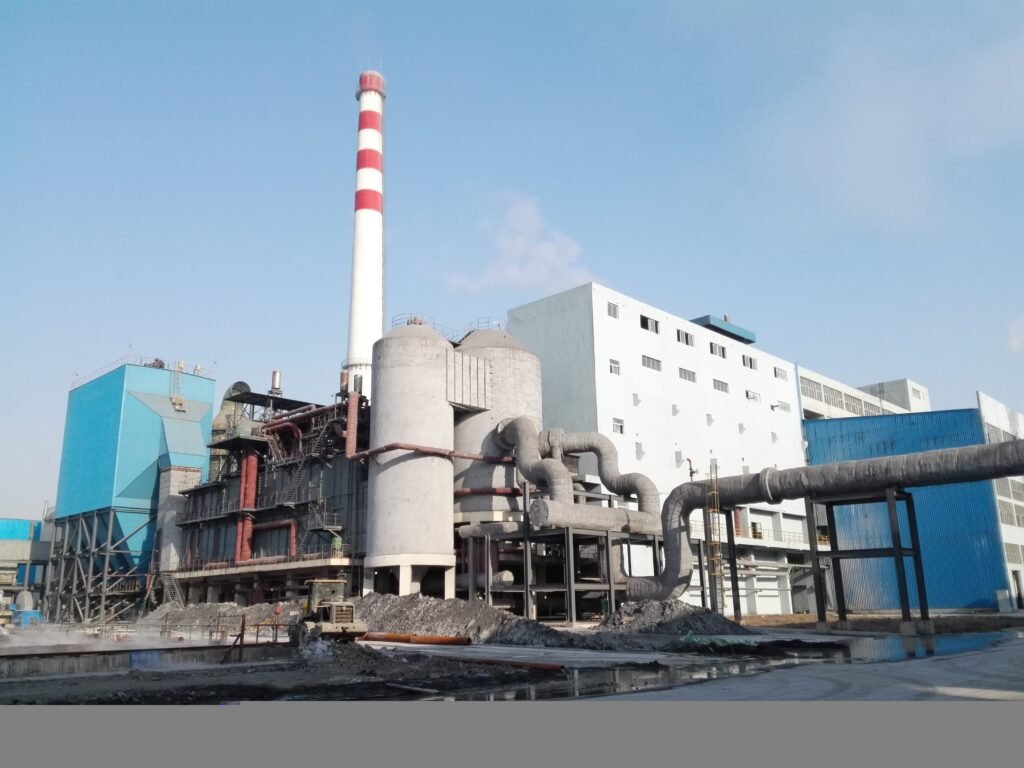
Waste heat recovery boiler sizing begins by calculating how much usable heat is available from an industrial exhaust gas stream and determining how much steam that energy can generate. The appropriate boiler capacity depends on exhaust gas temperature, mass flow rate, composition, steam conditions, operating loads, and practical heat-transfer limitations.
The basic sizing process involves four stages: assessing the heat source, estimating recoverable thermal duty, calculating feasible steam generation, and selecting a preliminary rated capacity based on plant demand.
This guide explains each stage, provides a worked calculation example, and identifies the technical information needed before requesting a detailed boiler design or quotation.
1. What Does Waste Heat Recovery Boiler Sizing Involve?
A conventional fuel-fired boiler is generally sized primarily around the steam or heat demand it must satisfy. A waste heat recovery boiler (WHRB), however, operates within the energy limitations of an existing industrial process.
Before selecting a capacity, three quantities must be distinguished:
- Recoverable Thermal Duty (kW or MW): The thermal energy potentially recoverable from exhaust gas under specified temperature and operating conditions.
- Feasible Steam Generation (kg/h or t/h): The estimated steam production supported by the available thermal duty and required steam conditions.
- Preliminary Rated Capacity (t/h): The proposed equipment capacity after considering steam demand, operating loads, and engineering constraints.
These quantities are related but not interchangeable.
In particular, the maximum steam output calculated from a simplified heat balance does not automatically represent the rated capacity that a manufacturer can guarantee.
2. Which Parameters Are Required for Waste Heat Recovery Boiler Sizing?
Accurate preliminary sizing requires data from both the exhaust gas source and the steam system.
Exhaust Gas Temperature, Flow Rate, and Composition
Exhaust gas temperature indicates the thermal condition of the available heat source, while mass flow determines how much hot gas passes through the recovery system.
A high exhaust gas temperature alone does not guarantee substantial steam generation. A relatively small gas flow may contain less recoverable energy than a larger flow at a lower temperature.
Gas composition also matters because it influences specific heat capacity and possible operating restrictions, including condensation, corrosion, and particulate deposition.
The allowable gas outlet temperature determines the assumed cooling range. It should not be selected arbitrarily simply to increase the calculated heat recovery.
Steam Pressure, Temperature, and Feedwater Conditions
Steam-side requirements determine how much energy is needed to generate each kilogram of steam.
The principal inputs are:
- Required steam pressure, specifying gauge or absolute pressure
- Saturated or superheated steam condition
- Required steam temperature, where applicable
- Feedwater inlet temperature and pressure
These values determine the specific enthalpy difference between incoming feedwater and outgoing steam.
For the same recoverable heat input, different steam pressures, steam states, and feedwater conditions can produce different steam generation rates.
Operating Load and Heat Source Availability
Many industrial processes operate under changing production loads.
Exhaust gas temperature and flow may fluctuate between normal, minimum, and maximum operating conditions. Intermittent processes may also have periods when no recoverable heat is available.
A useful preliminary sizing assessment must therefore consider representative operating conditions rather than relying on one isolated peak measurement.
Essential WHRB sizing parameters
| Parameter | Typical unit | Sizing significance |
|---|---|---|
| Exhaust gas inlet temperature | °C | Defines inlet thermal conditions |
| Exhaust gas mass flow rate | kg/h | Determines available gas heat flow |
| Gas composition | Gas analysis | Affects heat capacity and operating limitations |
| Average gas specific heat | kJ/(kg·K) | Supports preliminary sensible-heat calculations |
| Assumed gas outlet temperature | °C | Defines the proposed cooling range |
| Steam pressure | MPa or bar | Determines steam properties |
| Steam state and temperature | Saturated or °C | Determines steam outlet enthalpy |
| Feedwater temperature | °C | Determines feedwater enthalpy |
| Operating load profile | Process conditions | Establishes normal and limiting cases |
When gas flow is reported in Nm³/h rather than kg/h, conversion requires a defined reference temperature and pressure, gas composition, and dry or wet basis.
Actual m³/h and Nm³/h should not be used interchangeably.
The U.S. Department of Energy’s Waste Heat Recovery: Technology and Opportunities in U.S. Industry identifies heat quantity, temperature, composition, minimum allowable temperature, and operating schedules as important factors in industrial waste heat recovery assessments.
3. How to Calculate Waste Heat Recovery Boiler Capacity Step by Step
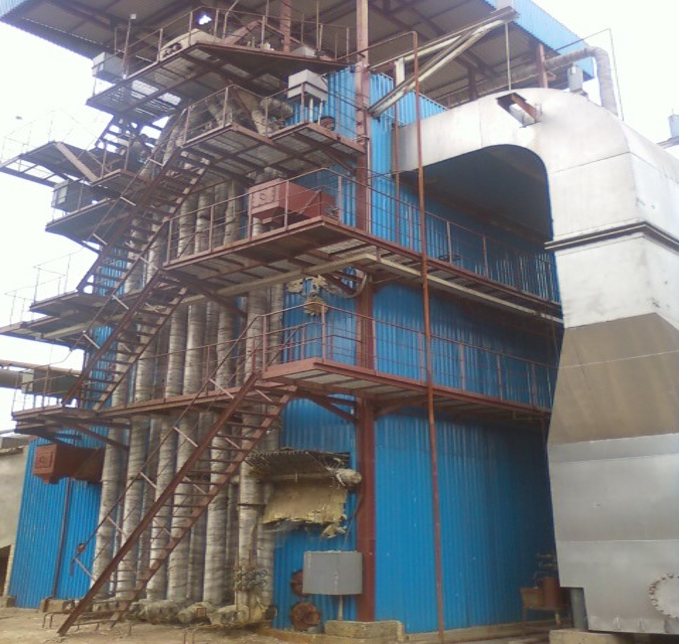
Preliminary capacity calculation involves estimating the heat released by the exhaust gas and then determining the steam production that this heat can support.
The calculation should distinguish between the heat theoretically released over an assumed cooling range, the net heat available to generate steam, and the output achievable in a practical boiler configuration.
Step 1 — Estimate Recoverable Thermal Duty from Exhaust Gas
For a non-condensing exhaust gas stream, a simplified sensible-heat equation is:
Q_g = m_g × c_p,g × (T_in − T_out) / 3,600
Where:
- Q_g: Exhaust gas sensible heat release, kW
- m_g: Exhaust gas mass flow rate, kg/h
- c_p,g: Average gas specific heat capacity, kJ/(kg·K)
- T_in: Exhaust gas inlet temperature, °C
- T_out: Assumed exhaust gas outlet temperature, °C
The factor 3,600 converts kJ/h into kW.
This equation assumes that the gas composition remains effectively unchanged and that an appropriate average specific heat capacity can represent the selected temperature range.
For gases with significant temperature-dependent properties, a gas enthalpy calculation is preferable:
Q_g = m_g × (h_g,in − h_g,out) / 3,600
Here, both gas enthalpies must be calculated on a consistent mass and reference basis.
An important limitation: The assumed gas outlet temperature must be technically achievable.
In a real waste heat boiler, the gas-to-water/steam temperature profile must maintain sufficient temperature differences throughout the heat-transfer sections.
For a boiler with an evaporator, the pinch point is commonly defined as the difference between the gas temperature leaving the evaporator and the saturation temperature at the corresponding steam pressure.
An excessively small temperature difference may require impractically large heat-transfer surfaces or make the proposed duty unachievable.
The Electric Power Research Institute’s technical report on heat recovery steam generators discusses pinch and approach temperatures as important design considerations affecting steam generation and heat recovery performance.
Therefore, calculating the total heat released by gas cooling does not, by itself, establish that the boiler can recover that amount.
Step 2 — Convert Available Heat into Steam Generation Capacity
Once the exhaust gas heat release has been estimated, the next step is to determine the net thermal duty available for steam generation.
For a simplified steady-state calculation:
m_s = 3,600 × Q_useful / (h_s − h_fw)
Where:
- m_s: Estimated steam generation, kg/h
- Q_useful: Net thermal duty available for steam generation, kW
- h_s: Outlet steam specific enthalpy, kJ/kg
- h_fw: Inlet feedwater specific enthalpy, kJ/kg
This relationship assumes that relevant heat losses and other heat-balance effects have been accounted for, and that blowdown and other mass-flow differences are negligible for the preliminary example.
The steam-side enthalpy rise includes the energy needed to heat feedwater to the required condition and generate saturated or superheated steam.
It is therefore incorrect to use only the latent heat of vaporization when feedwater enters below saturation temperature.
Reliable water and steam property values can be calculated using the IAPWS Industrial Formulation 1997 (IAPWS-IF97), developed for industrial thermodynamic calculations.
For an actual project, a more complete heat and mass balance should account for boiler blowdown, heat losses, and other relevant energy flows.
Step 3 — Worked Example: Estimating WHRB Steam Capacity
Consider an industrial facility evaluating a waste heat recovery boiler connected to a hot exhaust gas stream.
Important: All input values below are hypothetical engineering assumptions used exclusively to demonstrate the sizing method. They are not operating measurements, manufacturer-guaranteed values, or data from a Taishan Group project.
Illustrative input conditions
| Parameter | Assumed value |
|---|---|
| Exhaust gas inlet temperature | 400°C |
| Assumed exhaust gas outlet temperature | 220°C |
| Exhaust gas mass flow | 36,000 kg/h |
| Average exhaust gas specific heat | 1.10 kJ/(kg·K) |
| Required steam condition | Saturated steam |
| Steam pressure | 1.0 MPa absolute [10 bar(a)] |
| Feedwater temperature | 100°C |
| Illustrative heat-loss allowance | 5% of calculated gas heat release |
The selected gas heat capacity and outlet temperature are illustrative inputs, not validated design parameters for a particular exhaust gas source.
The 5% loss allowance is included only to demonstrate how an assumed loss changes calculated steam output. It is not a recommended universal WHRB efficiency or heat-loss factor.
Calculation A: Determine Exhaust Gas Sensible Heat Release
First, calculate the assumed exhaust gas temperature difference:
ΔT = 400 − 220 = 180 K
Substituting into the sensible-heat equation:
Q_g = 36,000 × 1.10 × 180 / 3,600
Q_g = 1,980 kW
Under the specified assumptions, the exhaust gas releases approximately 1.98 MW of sensible heat while cooling from 400°C to 220°C.
This is the gross heat-balance result for the selected cooling range, not confirmed recoverable boiler duty.
Calculation B: Determine Steam-Side Enthalpy Rise
At 1.0 MPa absolute pressure, the specific enthalpy of saturated steam is approximately:
h_s = 2,777 kJ/kg
For pressurized feedwater at 100°C, an appropriate rounded preliminary value is:
h_fw ≈ 420 kJ/kg
Therefore:
Δh = 2,777 − 420
Δh = 2,357 kJ/kg
These rounded values are consistent with IAPWS-based water and steam properties.
Calculation C: Calculate the Idealized Steam-Output Ceiling
First, consider a simplified heat balance that assumes all 1,980 kW of gas sensible heat release is transferred to steam generation, with no losses or blowdown.
m_s = 3,600 × 1,980 / 2,357
m_s ≈ 3,024 kg/h
Idealized steam-output ceiling ≈ 3.02 t/h
This figure is an upper limit under the specified gas cooling and steam conditions when heat losses are ignored.
It is not the absolute thermodynamic maximum available from the heat source, nor proof that a practical boiler can achieve the assumed exhaust gas outlet temperature.
Calculation D: Estimate Steam Output with an Illustrative Loss Allowance
For comparison, apply the explicitly assumed 5% heat-loss allowance:
Q_useful = 1,980 × (1 − 0.05)
Q_useful = 1,881 kW
Using the same steam-side enthalpy difference:
m_s = 3,600 × 1,881 / 2,357
m_s ≈ 2,873 kg/h
Illustrative steam generation ≈ 2.87 t/h
The result is lower because the assumed net useful duty is lower.
Summary of the preliminary calculation
| Calculation item | Result |
|---|---|
| Exhaust gas sensible heat release | 1,980 kW |
| Idealized steam-output ceiling, ignoring losses | 3.02 t/h |
| Net useful duty with illustrative 5% allowance | 1,881 kW |
| Steam output under the illustrative allowance | 2.87 t/h |
| Manufacturer-confirmed rated capacity | Not yet determined |
What Does the 2.87 t/h Result Actually Mean?
The calculation suggests that the hypothetical exhaust gas stream could support approximately 2.87 t/h of saturated steam under the stated assumptions.
However, this result depends on several conditions that have not yet been verified:
- The actual gas properties and flow must match the assumed values.
- The proposed 220°C exhaust gas outlet temperature must be achievable.
- The heat-transfer temperature profile must satisfy practical pinch-point and other thermal constraints.
- Allowable gas-side pressure drop, fouling, and operating-load variations must be considered.
- The actual heat and mass balance must account for losses, blowdown, and other relevant system conditions.
Consequently, 2.87 t/h should be treated as an illustrative preliminary steam-output estimate, not a guaranteed boiler rating.
A manufacturer must confirm the feasible capacity through detailed thermal calculations and equipment design.
4. How to Select an Appropriate Preliminary Rated Boiler Capacity
Calculating potential steam generation is only part of the sizing process.
The next question is whether the estimated output is appropriate for the facility’s actual steam demand and operating conditions.
Compare Calculated Steam Output with Plant Steam Demand
Using the illustrative 2.87 t/h result, consider three hypothetical plant demand scenarios.
| Normal steam demand | Preliminary interpretation |
|---|---|
| 2.0 t/h | Estimated output exceeds demand by approximately 0.87 t/h. Excess heat or steam management must be considered. |
| 2.87 t/h | Demand approximately matches the calculated output, but operating variability and engineering feasibility must still be verified. |
| 3.5 t/h | Estimated output is approximately 0.63 t/h below demand. Additional steam supply may be required. |
These comparisons assume that the calculated 2.87 t/h steam output is available under the same normal operating conditions.
They do not represent independently verified boiler performance.
Scenario 1: Available Waste Heat Exceeds Steam Demand
If the plant normally requires only 2.0 t/h, maximizing steam production may not be necessary.
The project must determine whether surplus steam can be used elsewhere or whether the heat recovery system should operate at a lower steam output.
Depending on the process and equipment arrangement, suitable control or exhaust gas bypass provisions may need evaluation.
Scenario 2: Available Waste Heat Approximately Matches Demand
When demand is close to the estimated steam output, the system may appear suitable under the assumed normal conditions.
However, small changes in exhaust gas flow, inlet temperature, steam pressure, or feedwater conditions may change the available steam production.
The project should not assume that the estimated output will always be available.
Scenario 3: Available Waste Heat Is Insufficient
If demand is 3.5 t/h while estimated production is 2.87 t/h, the preliminary deficit is approximately 0.63 t/h.
The plant may need to retain or introduce another steam source.
The appropriate solution depends on the overall steam system and should not be decided solely from the waste heat boiler calculation.
Evaluate Normal, Minimum, and Peak Operating Conditions
Industrial heat sources rarely operate at exactly the same temperature and flow rate throughout the year.
The proposed boiler must therefore be evaluated under relevant operating cases.
| Operating case | Main capacity consideration |
|---|---|
| Normal load | Establishes expected continuous steam generation under representative operating conditions |
| Minimum load | Checks available steam output and stable operation when process heat availability decreases |
| Peak load | Verifies maximum thermal duty and equipment operating limits |
For example, a boiler that can generate 2.87 t/h under the illustrative normal conditions may produce less steam when the upstream process operates at a lower load.
The actual change must be calculated using the corresponding exhaust gas conditions. Steam output cannot automatically be assumed to vary in direct proportion to production load.
Likewise, a higher exhaust gas flow or temperature may increase the thermal duty imposed on the equipment, even if the connected steam system does not require additional steam.
The selected design basis should therefore distinguish between rated operating conditions, normal expected output, and allowable operating limits.
Translate Calculated Output into a Preliminary Capacity Recommendation
A practical sizing decision follows this sequence:
Calculated Steam Output → Operating-Case Assessment → Steam Demand Matching → Preliminary Capacity → Manufacturer Verification
In the worked example, 2.87 t/h can be used as a starting estimate for the assumed operating case.
It would be premature to specify a 3 t/h rated boiler simply by rounding the calculated number upward.
Before a rated capacity can be confirmed, the manufacturer must evaluate:
- Design exhaust gas flow and temperature
- Steam pressure and required steam condition
- Feasible heat-transfer duty and temperature profile
- Allowable gas-side pressure drop
- Minimum and maximum operating conditions
- Steam-water circulation and relevant pressure-part design requirements
There is no universally appropriate percentage by which every calculated WHRB capacity should be increased.
The final capacity must be associated with defined operating conditions and supported by the manufacturer’s engineering calculations.
5. What Practical Engineering Constraints Can Limit WHRB Capacity?
A heat balance identifies the energy potentially released by the exhaust gas. Practical boiler design determines how much of that energy can actually be transferred and used.
Several factors may reduce the achievable capacity.
| Engineering constraint | Effect on achievable steam generation |
|---|---|
| Minimum allowable exhaust temperature | Condensation, corrosion, or downstream process requirements may restrict gas cooling |
| Heat-transfer temperature difference | Insufficient temperature differences may prevent the proposed duty from being achieved |
| Dust loading and fouling | Deposits can reduce effective heat transfer and alter performance |
| Allowable gas-side pressure drop | Excessive flow resistance may interfere with the upstream process or exhaust system |
Minimum Exhaust Temperature
Cooling exhaust gas to a lower temperature generally increases the calculated sensible heat release.
However, the permissible temperature depends on gas composition, moisture, contaminants, materials, and downstream requirements.
The U.S. Department of Energy’s industrial waste heat recovery report discusses minimum allowable temperatures and the corrosion risks associated with exhaust gas condensation.
Heat-Transfer Temperature Difference
Even when sufficient energy appears available in the overall heat balance, the local gas and water/steam temperature profile may limit the transferable duty.
For boilers with economizer and evaporator sections, minimum temperature differences must be assessed across the relevant heat-transfer surfaces.
Dust and Fouling
Exhaust gas containing significant particulate matter may create deposits on heat-transfer surfaces. This can reduce heat-transfer performance and influence the practical boiler configuration.
Gas-Side Pressure Drop
A WHRB introduces resistance into the exhaust gas path.
The permissible pressure drop must be compatible with the upstream production equipment and exhaust handling system.
These limitations do not invalidate preliminary calculations. They explain why thermal capacity estimation and engineering capacity verification are separate stages of boiler sizing.
6. What Data Should Buyers Provide for Preliminary WHRB Sizing?
A manufacturer can evaluate a proposed waste heat recovery boiler more effectively when the heat source conditions, steam requirements, and operating limits are clearly documented.
The following checklist can be used to prepare a preliminary technical inquiry.
Preliminary WHRB Sizing Data Checklist
| Required information | Recommended data |
|---|---|
| Industrial process | Furnace, kiln, heater, or other exhaust gas source |
| Exhaust gas inlet temperature | °C at proposed WHRB inlet |
| Exhaust gas flow rate | kg/h or Nm³/h, with measurement basis |
| Gas composition | Major constituents and relevant contaminants |
| Dust concentration | Available particulate loading information |
| Permissible gas outlet temperature | °C and process limitations |
| Maximum allowable gas-side pressure drop | Pa or kPa |
| Required steam capacity | t/h |
| Required steam pressure | MPa or bar, specifying gauge or absolute |
| Steam state and temperature | Saturated or superheated, °C where applicable |
| Feedwater conditions | Temperature and pressure |
| Operating load profile | Normal, minimum, and maximum conditions |
| Operating schedule | Hours per day and days per year |
| Installation limitations | Available space and relevant duct connection constraints |
Measured operating data should be preferred whenever available.
If certain information is missing, preliminary calculations may still be possible using documented assumptions or reliable process mass-balance data.
However, the uncertainty of those assumptions should be identified.
For example, exhaust gas temperature without a defensible flow estimate is insufficient to establish steam generation capacity reliably.
Likewise, a required steam flow cannot confirm the feasibility of a WHRB unless the available heat source has been assessed.
For equipment information, buyers can review Taishan Group’s Waste Heat Recovery Boiler product page.
Waste Heat Boiler Project References
Taishan Group’s published project portfolio includes the supply of one high-pressure steam drum and one low-pressure steam drum for a waste heat boiler project associated with the Parnaíba Complex in Brazil.
The portfolio also identifies steam drum supply for an 18 t/h waste heat boiler project associated with POSCO Steeleon in South Korea.
These references demonstrate involvement in waste heat boiler equipment supply under different project conditions.
The published descriptions do not provide the full exhaust gas and steam-side operating data needed to reproduce the boilers’ thermal sizing calculations. Therefore, the worked example in this guide is independent of these projects.
7. Frequently Asked Questions About Waste Heat Recovery Boiler Sizing
Can WHRB Capacity Be Estimated Without Measured Exhaust Gas Flow?
A preliminary screening estimate may be possible using reliable process mass-balance information. However, gas mass flow is essential to the thermal calculation. Without measured or otherwise defensible flow data, the estimated steam capacity may have considerable uncertainty and should not be treated as a confirmed design value.
Can the Same Waste Heat Source Generate Equal Amounts of Saturated and Superheated Steam?
Not necessarily. Saturated and superheated steam have different specific enthalpies under their respective operating conditions. The required enthalpy rise affects steam production, while superheating introduces additional heat-transfer requirements. Therefore, both steam output and thermal feasibility must be evaluated for the specified steam conditions.
What Checks Are Needed Before a Manufacturer Confirms Rated Steam Capacity?
A manufacturer should verify the heat and mass balance, heat-transfer temperature profile, feasible exhaust gas outlet conditions, pressure drop, operating-load range, and relevant boiler design requirements. The confirmed rating must correspond to clearly specified exhaust gas and steam conditions.
Conclusion
Waste heat recovery boiler sizing should begin with reliable exhaust gas data, followed by an assessment of recoverable thermal duty and feasible steam generation.
The calculated output must then be compared with actual plant steam demand and verified across relevant operating conditions.
A preliminary steam calculation provides a starting point—not a guaranteed boiler rating.
To obtain a project-specific capacity assessment, contact Taishan Group with your exhaust gas temperature, flow rate, steam requirements, and available operating data.
References
U.S. Department of Energy. Waste Heat Recovery: Technology and Opportunities in U.S. Industry. March 2008. Read the technical report.
International Association for the Properties of Water and Steam (IAPWS). Revised Release on the IAPWS Industrial Formulation 1997 for the Thermodynamic Properties of Water and Steam. IAPWS R7-97(2012). View the official formulation.
Electric Power Research Institute (EPRI). Delivering High Reliability Heat Recovery Steam Generators. Technical Report 1004240, March 2003. Read the technical report.
How to Size a Waste Heat Recovery Boiler? Key Parameters for Capacity Planning Read More »