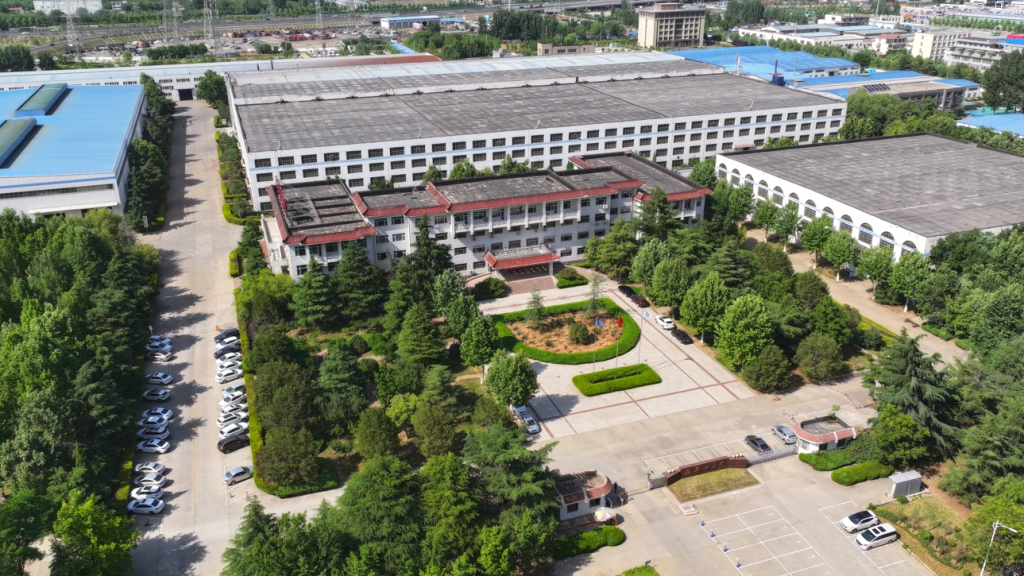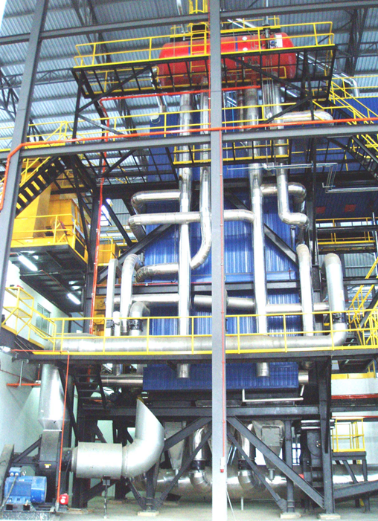
Correct power plant boiler sizing begins with the steam turbine and the complete plant steam balance—not with a fixed conversion between boiler TPH and electrical MW.
Two turbines with the same generating capacity may require very different steam flows because of differences in turbine type, inlet pressure and temperature, exhaust pressure, process extraction and efficiency. The boiler must also account for external steam users, genuine system losses, fuel characteristics, minimum operating load and redundancy requirements.
For a final equipment selection, the boiler manufacturer should review the turbine heat balance, guaranteed fuel analysis and expected operating cases together.
Power Plant Boiler Sizing at a Glance
| Key question | Practical answer |
|---|---|
| Can boiler TPH be converted directly to electrical MW? | No. Turbine type, steam conditions, exhaust pressure and efficiency must also be known. |
| What is the main boiler-sizing input? | The turbine supplier’s guaranteed admission steam flow and heat balance. |
| How is preliminary boiler capacity calculated? | Turbine admission flow plus external steam demand, other verified steam consumers, genuine steam losses and a justified design margin. |
| What determines boiler thermal duty? | Steam flow and the enthalpy difference between boiler outlet steam and feedwater. |
| What determines fuel consumption? | Boiler heat duty, boiler efficiency and the fuel’s LHV or HHV. |
| What must be checked before final selection? | Minimum stable load, fuel range, redundancy, site conditions, auxiliary consumption and applicable standards. |
Quick answer: Size the boiler from the turbine’s guaranteed steam requirement, then add only the steam demands and losses that are not already included in the turbine heat balance. Confirm the result against steam conditions, fuel quality, minimum load and plant availability requirements.
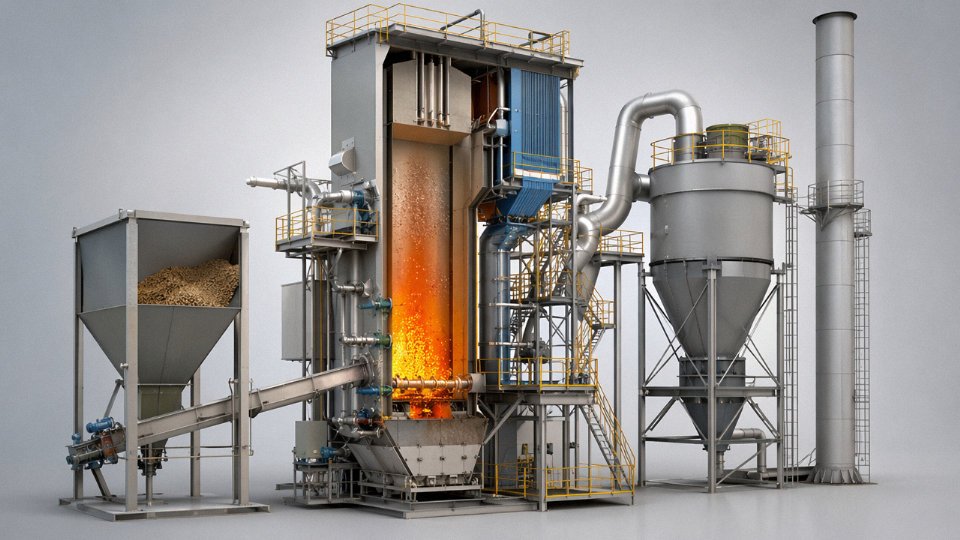
Can Boiler TPH Be Converted Directly to MW?
Boiler TPH cannot be converted directly into electrical MW unless the complete steam-cycle conditions are known.
TPH represents the mass of steam produced per hour. MW can refer to boiler thermal output, gross generator output, net exported electricity or the combined output of a CHP system. These values are related, but they are not interchangeable.
The amount of electricity produced from one tonne of steam depends on:
- Turbine inlet pressure and temperature;
- Turbine exhaust or condenser pressure;
- Turbine type;
- Turbine and generator efficiency;
- Process-steam extraction;
- Reheat arrangement;
- Gross versus net power output.
For example, EPA representative back-pressure turbine systems show substantially different steam-to-power ratios. Its published examples use approximately 20,050, 152,600 and 494,464 lb/h of steam for three turbine systems of different capacities and operating conditions. The corresponding inlet pressures range from 500 to 700 psig, and the turbine-generator efficiencies also differ. (US EPA)
This means that values such as “10 TPH per MW” or “15 TPH per MW” may happen to resemble a particular project, but they should never be treated as universal design rules.
Thermal MW and Electrical MW Are Different
Boiler thermal output can be calculated from the amount of energy added to the feedwater and steam. Electrical output requires another conversion step through the turbine and generator.
A boiler may therefore have a thermal output far greater than the generator’s electrical output. This is particularly noticeable in back-pressure CHP plants, where a large part of the fuel energy remains in the turbine exhaust steam for process use.
What Does Power Plant Boiler Capacity Mean?
Power plant boiler capacity is commonly expressed in tonnes of steam per hour, abbreviated as t/h or TPH. It may also be stated in kg/h or lb/h.
However, a steam-capacity figure is meaningful only when its design conditions are stated. These normally include boiler outlet pressure and temperature, feedwater temperature, fuel characteristics and the applicable continuous operating condition.
A 75 TPH boiler producing moderate-pressure saturated steam does not have the same thermal duty as a 75 TPH boiler producing high-pressure superheated steam.
| Parameter | Typical unit | Meaning |
|---|---|---|
| Steam capacity | t/h | Mass of steam produced per hour |
| Boiler thermal output | MWth | Heat transferred to water and steam |
| Fuel thermal input | MWth | Energy entering the boiler with fuel |
| Gross electrical output | MWe | Generator output before plant auxiliaries |
| Net electrical output | MWe | Power exported after auxiliary consumption |
| Maximum Continuous Rating | t/h or MWth | Maximum output the boiler is designed to sustain continuously |
What Is Maximum Continuous Rating?
Maximum Continuous Rating, or MCR, is the maximum output that the boiler is designed to maintain continuously under the specified fuel and operating conditions.
MCR is not necessarily the load at which the boiler will operate most of the year. A project should therefore check:
- Maximum required steam flow;
- Normal continuous demand;
- Minimum stable operating load;
- Short-duration peaks;
- Maintenance and standby conditions.
Selecting a boiler only from the highest theoretical demand can result in an oversized unit that operates inefficiently during normal production.
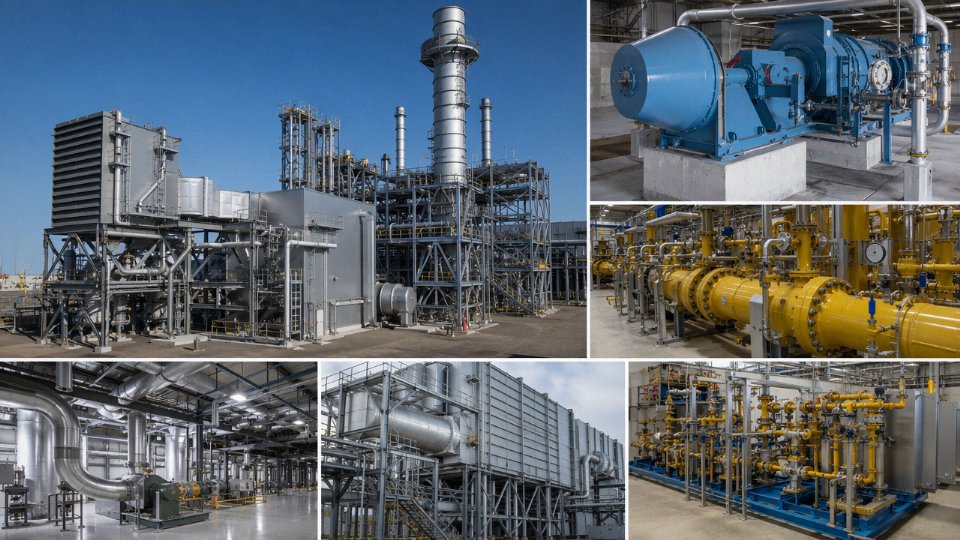
How Does Turbine Type Affect Boiler Capacity?
The turbine arrangement strongly affects the steam flow required for a given electrical output.
Condensing Steam Turbine
A condensing turbine expands steam to a low exhaust pressure and discharges it to a condenser. It is normally selected when electricity generation is the main objective.
The low exhaust pressure allows more energy to be extracted from each kilogram of steam. However, output is sensitive to condenser pressure, cooling conditions and ambient temperature. EPA notes that condensing turbines are designed to maximize power generation from the available steam supply. (US EPA)
Back-Pressure Steam Turbine
A back-pressure turbine discharges steam at a pressure that remains useful for a manufacturing process, district-heating system or another thermal load.
Because the exhaust steam still contains considerable usable energy, a back-pressure turbine normally generates less electricity per tonne of admission steam than a comparable condensing turbine. Its boiler capacity is therefore often determined by process-steam demand rather than electrical demand alone.
The turbine exhaust steam is already included in the main turbine admission flow. It must not be added again as a separate process-steam requirement.
Extraction-Condensing Steam Turbine
An extraction-condensing turbine removes part of the steam at one or more intermediate pressures, while the remaining steam continues through the turbine and enters a condenser.
Its steam balance must normally be checked under several operating cases:
| Operating case | Main concern |
|---|---|
| Maximum electrical output | Turbine admission flow and condenser conditions |
| Maximum process extraction | Required extraction flow and remaining turbine flow |
| Minimum thermal demand | Turbine operation with reduced extraction |
| Seasonal operation | Changing relationship between heat and power demand |
| Turbine bypass operation | Direct steam supply when the turbine is unavailable |
EPA explains that the distribution of steam between process extraction and condensation changes according to the plant’s heat and power requirements. (US EPA)
Power-Only Plant Versus CHP
A power-only system is normally optimized around electrical output.
A CHP system must satisfy both power demand and useful thermal demand. In many back-pressure CHP projects, process steam is the principal design requirement and electricity is generated while reducing steam pressure.
That is why turbine type must be confirmed before boiler capacity is estimated.
How Much Steam Does the Turbine Require?
The most reliable sizing input is the turbine supplier’s heat balance and guaranteed performance data.
The heat balance should identify:
| Required turbine data | Why it matters |
|---|---|
| Admission steam flow | Establishes the principal boiler steam requirement |
| Inlet pressure and temperature | Determines the boiler outlet conditions |
| Exhaust or condenser pressure | Determines the usable turbine energy drop |
| Extraction flow and pressure | Defines CHP or process-steam operation |
| Gross generator output | Links steam conditions to electrical output |
| Part-load cases | Shows how the system behaves below rated load |
Steam turbines are frequently designed around project-specific inlet, exhaust and extraction conditions. EPA describes steam turbines as highly configurable machines that can be matched to different pressure, temperature and thermal-output requirements. (US EPA)
Preliminary Steam-Flow Estimate
When turbine supplier data are not yet available, a preliminary thermodynamic estimate can be made:
Estimated turbine steam flow (kg/s) = Electrical output (MW) × 1,000 ÷ [Actual turbine enthalpy drop (kJ/kg) × Mechanical efficiency × Generator efficiency]
The actual enthalpy drop must be calculated from the turbine inlet and exhaust conditions. Reliable water and steam properties should be used.
IAPWS-IF97 is specifically intended for industrial calculations of thermodynamic properties such as enthalpy, entropy, density and heat capacity in steam-power applications. (International Association for the Properties of Water Vapour)
Engineering note: This formula is suitable for feasibility studies only. Final boiler sizing should be based on the turbine supplier’s guaranteed steam consumption.
How Is Required Boiler Steam Flow Calculated?
Start with the verified turbine admission flow. Then identify every steam user that is not already included in the turbine heat balance.
Required boiler steam output = Turbine admission flow + Direct external steam demand + Other verified steam consumers + Genuine steam mass losses
Turbine Admission Flow
Use the maximum verified turbine admission flow for the selected design case. Do not estimate it solely from the generator’s nominal MW rating.
Direct Steam Demand Outside the Turbine
Some steam may be supplied without passing through the turbine. Typical examples include a direct process header, start-up steam, turbine bypass steam or steam exported to another facility.
Only steam that is genuinely outside the turbine balance should be added.
Boiler and Plant Steam Consumers
Some plants use steam for soot blowing, fuel-oil atomization, steam tracing, air heating, deaeration or equipment warm-up.
These consumers should be checked against the turbine and plant heat balance. For example, deaerator steam may already be supplied from a turbine extraction. Adding it again would oversize the boiler.
Genuine Steam Losses
A preliminary balance may include reasonable allowances for vents, leaks, drains, intermittent consumers and non-recovered steam.
Pipeline heat loss is an energy loss, but it does not automatically represent an equal loss of steam mass. Heat loss should therefore be handled through the thermal balance rather than added blindly as extra TPH.
How Should Boiler Blowdown Be Treated?
Blowdown increases feedwater demand and fuel input, but it is not turbine steam.
The basic mass relationship is:
Boiler feedwater flow = Boiler steam output + Blowdown flow
The appropriate blowdown rate depends on boiler pressure, makeup-water quality and the water-treatment programme. DOE guidance states that blowdown is used to control dissolved solids and that excessive blowdown wastes energy, water and chemicals. (The Department of Energy’s Energy.gov)
Blowdown should therefore be included in the boiler water and heat balance—not simply added to the turbine’s required steam flow.
What Steam Pressure and Temperature Are Required?
Boiler outlet pressure and temperature should be determined from the turbine inlet guarantee point.
The boiler outlet may need to be slightly higher than the turbine inlet requirement because of:
- Main-steam piping pressure drop;
- Heat loss between boiler and turbine;
- Control-valve pressure drop;
- Steam-temperature control;
- Measurement and operating allowances.
Does a Steam Turbine Require Superheated Steam?
Steam turbines generally use superheated steam. In the conventional Rankine cycle, water is pressurized, evaporated and normally superheated before expansion through the turbine. (US EPA)
Superheat provides additional usable energy and helps limit excessive moisture during expansion. The required temperature depends on turbine design, pressure ratio, exhaust conditions, material limits and permitted final-stage moisture.
Does Higher Pressure Always Mean More Power?
Higher pressure alone does not guarantee proportionally greater turbine output.
The usable energy depends on the complete inlet and exhaust states. Pressure, temperature, turbine efficiency and exhaust pressure must be evaluated together.
Higher steam conditions may increase the usable enthalpy drop, but they can also require thicker pressure parts, higher-grade materials and more demanding temperature control. The optimal conditions are therefore an economic and technical system decision, not simply “the highest possible pressure.”
How Much Boiler Capacity Margin Should Be Added?
A design margin should cover identifiable uncertainty. It should not be an arbitrary percentage added to every project.
A reasonable margin may account for uncertain early-stage measurements, short-duration load variation, limited fuel variation, small unaccounted steam losses and normal performance degradation.
It should not be used to hide missing information such as an unknown turbine heat balance, incomplete fuel analysis or undefined future expansion.
Why Can Oversizing Be Harmful?
A significantly oversized boiler may spend much of its operating life below its preferred load range. Depending on the fuel and firing technology, this can lead to lower efficiency, unstable combustion, excessive auxiliary consumption, poor emission performance and difficulty maintaining steam temperature.
Oversizing also increases initial investment and may create more frequent start-stop operation if the unit cannot remain stable at the plant’s minimum demand.
Minimum Stable Load Matters
The selected boiler must meet the maximum steam requirement while remaining stable at the lowest normal operating demand.
Minimum load depends on factors such as:
- Fuel properties;
- Furnace and burner design;
- Grate or fluidized-bed system;
- Steam-temperature control;
- Emission-control equipment;
- Required load-following rate.
A technically correct maximum capacity can still be a poor selection if the boiler cannot operate reliably during low-demand periods.
One Large Boiler or Multiple Boilers?
A dedicated turbine may use one boiler, while a common steam-header system may use several units.
Multiple boilers can improve load flexibility, phased expansion and maintenance availability. However, they also add equipment, controls and operating complexity.
N+1 does not automatically mean installing one complete 100% standby boiler. Standby capacity should be based on the critical load that must remain available when the largest operating unit is unavailable.
How Are Boiler Thermal Duty and Fuel Consumption Calculated?
Once steam flow and steam conditions are known, the steam-side thermal duty can be estimated.
Boiler Steam-Side Duty
Boiler steam-side duty (MWth) = Steam flow (kg/s) × [Steam enthalpy − Feedwater enthalpy] (kJ/kg) ÷ 1,000
Steam enthalpy is determined from the boiler outlet pressure and temperature. Feedwater enthalpy depends mainly on feedwater temperature and pressure.
Two boilers producing the same steam flow and outlet conditions may require different fuel inputs if their feedwater temperatures differ. Reliable steam-property data should therefore be used for both values. IAPWS-IF97 is designed for this type of industrial calculation. (International Association for the Properties of Water Vapour)
The heat added to blowdown water and any other boiler duties should also be included where relevant.
Required Fuel Input
Required fuel input (MWth) = Total boiler heat duty (MWth) ÷ Boiler efficiency
For a solid or liquid fuel:
Fuel consumption (kg/h) = Required fuel input (MWth) × 3,600 ÷ Fuel LHV (MJ/kg)
For natural gas:
Gas consumption (Nm³/h) = Required fuel input (MWth) × 3,600 ÷ Gas LHV (MJ/Nm³)
Boiler efficiency and fuel heating value must use the same basis. An LHV-based efficiency should be combined with an LHV fuel value; an HHV-based efficiency should be combined with HHV.
For coal, biomass and lignite, the moisture and heating-value basis should also be identified—for example, as-received, air-dried or dry basis.
Which Boiler Technology Matches Each Fuel?
Steam capacity is only one part of boiler selection. The firing technology must also match the guaranteed fuel range.
| Fuel category | Common boiler options | Main selection considerations |
|---|---|---|
| Natural gas and fuel oil | Package or field-erected water-tube boiler | Steam pressure, superheat temperature, load response and burner turndown |
| Consistent coal | Stoker, pulverized-coal or [CFB boiler](https://coalbiomassboiler.com/product/circulating-fluidized-bed-boiler/) | Capacity, coal size, ash, sulfur, volatile matter and emissions |
| Biomass | Traveling grate, reciprocating grate, BFB or CFB | Moisture, particle size, bulk density, ash chemistry and seasonal variation |
| Lignite and difficult fuels | Purpose-designed grate, BFB or CFB system | High moisture, low heating value, ash behaviour and fuel variability |
| Mixed fuels | Flexible grate or fluidized-bed system | Compatibility, blending range, feeding system and emission guarantees |
Natural Gas and Fuel Oil
High-pressure superheated steam for turbine service is generally produced in a water-tube boiler designed for the required pressure, temperature and load response.
A small low-pressure condensing fire-tube heating boiler should not be confused with a condensing steam turbine system.
Coal
Coal selection should consider much more than heating value. Ash content, sulfur, volatile matter, particle size and ash-fusion behaviour can influence the furnace, firing system, heating surfaces and emission controls.
Stoker systems may suit certain smaller or medium applications. CFB technology can offer wider fuel flexibility, while pulverized-coal firing is generally associated with larger and more uniform power-generation duties.
Biomass
Biomass should be evaluated through four groups of data: fuel condition, combustion characteristics, ash behaviour and expected variation.
Fuel-condition data include moisture, heating value, particle size and bulk density. Ash, alkali, chlorine and ash-fusion temperature help engineers evaluate fouling, slagging and corrosion risks. Seasonal changes in moisture and composition must be included in the guaranteed design range.
Grate-fired systems may suit relatively consistent biomass, while BFB or CFB systems may be considered where fuel properties vary more widely.
Lignite and Other Difficult Fuels
High-moisture or low-calorific-value fuels generally require more furnace volume and residence time than higher-grade fuels. They may also require revised air distribution, greater fuel-handling capacity and larger flue-gas equipment because more fuel must be processed for the same heat output.
Fuel preparation or drying may be considered in some projects. Where fuel quality changes widely, a fluidized-bed system may provide greater flexibility, but the final choice must be verified against the complete fuel analysis, emission limits and required operating range.
What Site Conditions Can Change the Final Boiler Size?
A preliminary steam-capacity calculation must be checked against the balance of plant.
| System or condition | Why it affects the final design |
|---|---|
| Altitude and ambient temperature | Affect combustion-air density, fan capacity and equipment cooling |
| Feedwater system | Feedwater temperature changes boiler thermal duty |
| Fuel handling | Must sustain the maximum fuel flow under the worst guaranteed fuel condition |
| Air and flue-gas system | Fan capacity and system resistance may limit boiler output |
| Emission controls | Dust collection, desulfurization and DeNOx add pressure loss and auxiliary power |
| Condenser and cooling system | Affect turbine exhaust pressure and electrical output |
| Electrical auxiliaries | Create the difference between gross and net plant output |
| Transport and plot restrictions | May determine whether equipment is shop-assembled or field-erected |
Condensing-turbine performance is particularly sensitive to exhaust pressure and cooling conditions. EPA notes that condensing-turbine power output changes with ambient and condenser conditions. (US EPA)
Which Boiler Codes May Apply?
The required construction standard depends on the project location, owner specification and regulatory jurisdiction.
ASME BPVC Section I covers the construction of power boilers and related components within its scope, including items such as economizers, superheaters and reheaters. (ASME Digital Collection)
EN 12952 applies to water-tube boilers and associated installations. BSI describes EN 12952-1 as covering water-tube boilers used to generate steam or hot water above its stated pressure and temperature thresholds. (BSI Knowledge Base)
The project must also consider applicable combustion-safety requirements, emission regulations, local inspection rules and contractual performance guarantees.
Worked Example: Preliminary Sizing of a Back-Pressure CHP Boiler
The following example demonstrates the sizing method. It is not a universal relationship between TPH and MW.
Published Turbine Benchmark
EPA provides a representative 3 MW back-pressure turbine case with the following conditions:
| Parameter | Published value |
|---|---|
| Electrical output | 3 MW |
| Turbine steam flow | 152,600 lb/h, approximately 69.2 t/h |
| Inlet pressure | 600 psig, approximately 4.14 MPa(g) |
| Inlet temperature | 575°F, approximately 302°C |
| Exhaust pressure | 150 psig, approximately 1.03 MPa(g) |
| Assumed boiler efficiency | 80% HHV |
| Published fuel input | 208.3 MMBtu/h |
These values are representative performance data, not the guarantee of a current Taishan project. (US EPA)
The apparent steam-to-power ratio is:
69.2 t/h ÷ 3 MW = approximately 23.1 t/h per MW
This high ratio reflects a back-pressure CHP arrangement in which considerable useful energy remains in the turbine exhaust steam.
A condensing turbine of the same electrical output could have a significantly different steam requirement.
Preliminary Plant Steam Balance
Assume that an early plant study identifies:
| Item | Preliminary value | Data type |
|---|---|---|
| Turbine admission flow | 69.2 t/h | Published benchmark |
| Direct high-pressure steam outside the turbine | 1.0 t/h | Engineering assumption |
| Other verified steam consumers and losses | 0.5 t/h | Engineering assumption |
| Preliminary capacity margin | 5% | Engineering assumption |
The preliminary boiler capacity is:
Preliminary boiler MCR = (69.2 + 1.0 + 0.5) × 1.05 = 74.3 t/h
An initial specification could therefore consider approximately 74–75 TPH, subject to confirmation of the turbine heat balance, fuel analysis, feedwater condition, minimum load and redundancy philosophy.
The 5% margin is used only to demonstrate the method. It is not a standard allowance for every project.
Important: Published input, engineering assumptions and calculated results should always be labelled separately. This prevents preliminary estimates from being mistaken for guaranteed design data.
What Does a Real Taishan CHP Project Show?
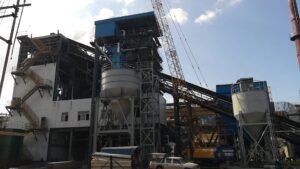
Taishan Group’s published project portfolio includes a Thai beverage-factory boiler-island EPC project with two 30 TPH spent-grain biomass boilers and one 9 MW back-pressure steam turbine-generator system. (Taishan Group)
The installed boiler capacity is therefore 60 TPH, while the turbine is rated at 9 MW. However, this should not be interpreted as a universal conversion of 6.67 TPH per MW.
It is a CHP system. The back-pressure turbine exhaust continues to serve the factory’s thermal demand, and the two-boiler arrangement may also reflect operating flexibility, steam-demand variation and maintenance requirements.
The public project information does not disclose the complete turbine heat balance, steam parameters or simultaneous process load. It would therefore be inappropriate to reconstruct the detailed sizing calculation from the published TPH and MW figures alone.
Taishan’s published project portfolio also lists a 75 TPH biomass boiler for combined electricity generation and process heating, as well as a 170 TPH biomass boiler supplying steam for grid electricity generation. These projects have different operating objectives, demonstrating why TPH-to-MW relationships should not be transferred from one plant to another. (Taishan Group)
What Data Are Required for a Power Plant Boiler Proposal?
A complete RFQ allows the boiler and turbine systems to be evaluated together.
| Data group | Information to provide |
|---|---|
| Power requirement | Gross output, net export requirement, generator voltage and frequency, grid-connected or island operation |
| Turbine | Turbine type, heat balance, guaranteed steam consumption, inlet conditions, exhaust pressure and extraction data |
| Steam system | Boiler outlet flow, pressure and temperature, feedwater temperature, process-steam flows, condensate return and blowdown basis |
| Fuel | Fuel type, source, LHV/HHV, proximate and ultimate analysis, moisture, ash, sulfur, particle size and fuel variation |
| Operation | Normal load, peak load, minimum load, annual hours, load curve, ramp rate and start-stop frequency |
| Availability | Standby philosophy, maintenance plan, critical steam demand and future expansion |
| Site | Location, altitude, ambient conditions, water availability, seismic data, transport limits and plot area |
| Environmental | Emission limits, stack requirements, monitoring requirements and waste-disposal conditions |
| Supply scope | Boiler island, fuel handling, water treatment, fans, emission controls, ash handling, electrical controls, erection and commissioning |
| Standards | Required construction code, inspection requirements and performance-test standard |
For biomass and coal, a generic fuel name such as “wood chips” or “bituminous coal” is not sufficient for final design. The guaranteed fuel range should be supported by an actual laboratory analysis.
What Are the Most Common Power Plant Boiler Sizing Mistakes?
Using a Fixed TPH-per-MW Conversion
This ignores turbine type, steam conditions, exhaust pressure and system efficiency.
Confusing Gross and Net Electrical Output
Gross output is measured at the generator. Net output is what remains after fans, pumps, fuel handling, cooling equipment and emission-control systems consume power.
Adding Process Steam Twice
Back-pressure exhaust or extraction steam may already be included in the turbine admission flow. Adding it again can substantially oversize the boiler.
Treating Blowdown as Turbine Steam
Blowdown increases feedwater and heat input, but it is not additional steam supplied to the turbine.
Ignoring Feedwater Temperature
Boiler heat duty depends on the energy rise from feedwater to final steam. The same TPH can require different fuel inputs at different feedwater temperatures.
Mixing LHV and HHV
Fuel heating value and boiler efficiency must use the same basis.
Applying an Arbitrary Oversizing Margin
A large general allowance can create permanent low-load operation and unnecessary capital cost.
Ignoring Minimum Stable Load
The boiler must operate reliably across the real plant load range—not only at its maximum rated output.
Frequently Asked Questions
How Many Tonnes of Steam Are Required to Generate 1 MW?
There is no universal value. Steam consumption depends on turbine type, inlet pressure and temperature, exhaust pressure, turbine efficiency, process extraction and whether the stated MW is gross or net.
The turbine supplier’s guaranteed steam rate should be used whenever possible.
How Do You Convert Boiler TPH to Thermal MW?
Use the steam flow and the enthalpy rise from feedwater to boiler outlet steam:
Boiler steam-side duty (MWth) = Steam flow (kg/s) × Enthalpy rise (kJ/kg) ÷ 1,000
This calculates thermal output, not generator electrical output.
How Do You Convert Boiler TPH to Electrical MW?
After calculating boiler thermal duty, turbine-cycle performance, mechanical efficiency, generator efficiency and auxiliary power must be considered.
TPH alone is insufficient to determine electrical MW.
Should a Power Plant Boiler Be Oversized?
A justified engineering margin may be appropriate, but excessive oversizing can increase capital cost and lead to prolonged low-load operation.
Normal margin, standby capacity and future expansion should be evaluated separately.
What Pressure Should a Power Plant Boiler Produce?
The required pressure is determined by the turbine inlet guarantee, main-steam piping pressure drop and control requirements.
There is no single pressure suitable for every power rating.
What Is the Most Important Document for Boiler Sizing?
For a steam-turbine project, the turbine heat balance is usually the most important starting document. It should be reviewed together with the plant steam balance, fuel analysis and expected operating cases.
Conclusion
Power plant boiler sizing should not begin with a universal MW-to-TPH conversion.
The correct sequence is to define the turbine type, obtain its guaranteed admission steam flow, identify additional steam demand, confirm pressure and temperature, apply a justified margin and check the boiler across the full operating range.
The preliminary steam rating must then be verified against:
- Boiler thermal duty;
- Feedwater condition;
- Fuel characteristics;
- Minimum stable load;
- Redundancy requirements;
- Auxiliary consumption;
- Site and environmental conditions.
Taishan Group’s published project portfolio includes biomass, coal, CFB and other boiler systems for power generation and combined heat and power applications, including the two-boiler, 9 MW back-pressure CHP project in Thailand. (Taishan Group)
For a preliminary technical proposal, provide the turbine heat balance, required steam conditions, guaranteed fuel analysis, expected load profile and project site data.
References
- EPA Catalog of CHP Technologies: Steam Turbines — turbine configurations, steam conditions and representative performance data. (US EPA)
- IAPWS Industrial Formulation 1997 — industrial calculation of water and steam thermodynamic properties. (International Association for the Properties of Water Vapour)
- U.S. Department of Energy: Minimize Boiler Blowdown — blowdown control and its effect on water and energy use. (The Department of Energy’s Energy.gov)
- ASME Boiler and Pressure Vessel Code, Section I — construction requirements for power boilers and related components within its scope. (ASME Digital Collection)
- BS EN 12952-1: Water-Tube Boilers and Auxiliary Installations — general scope and requirements for water-tube boilers. (BSI Knowledge Base)
- Taishan Group Power Plant Boiler Projects — published power-generation and CHP project references. (Taishan Group)
- Taishan Group Project Cases — published biomass, CFB, power and process-steam boiler references. (Taishan Group)