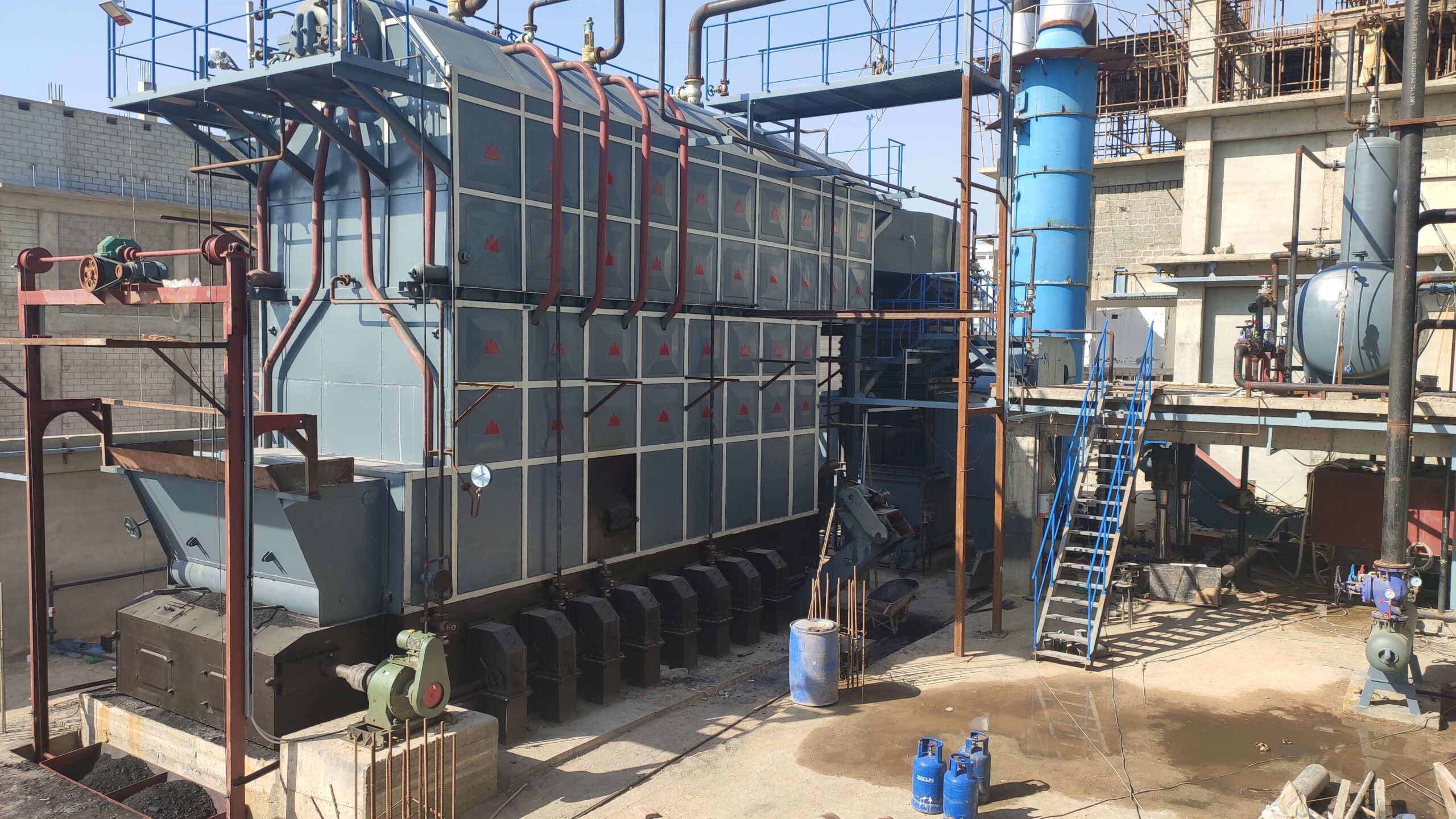
Industrial boiler safety does not depend on a single valve, sensor, controller, or operator action. A properly engineered boiler combines several protection layers to keep operation within acceptable limits, detect abnormal conditions, prevent unsafe firing, shut down fuel or heat input when required, and provide independent mechanical overpressure protection.
The exact protection architecture varies with boiler type, fuel, firing system, pressure, capacity, applicable codes, project specifications, and local jurisdiction. Boiler safety is therefore better understood as a layered protection system than as a universal checklist of identical devices.
What Are the Main Safety Features in an Industrial Boiler?
Industrial boiler protection can be grouped into four functional categories:
- Pressure protection — high-pressure limits and safety valves.
- Water-level protection — low-level alarms and protective low-water trips.
- Combustion and fuel protection — flame safeguards, Burner Management Systems (BMS), fuel shutoff valves, airflow permissives, and furnace-pressure protection.
- Control-system and emergency protection — alarms, permissives, interlocks, protective trips, Master Fuel Trip (MFT), and emergency shutdown functions.
| Hazard | Main Safety Feature | Typical Protective Action |
|---|---|---|
| Excess pressure | Safety valve | Relieves pressure |
| Excess steam pressure | High-pressure limit | Stops or inhibits firing |
| Critically low water level | Low-water protection | Removes heat input |
| Flame failure | Flame safeguard | Isolates fuel |
| Unsafe fuel conditions | Fuel interlock | Prevents or terminates firing |
| Insufficient combustion air | Airflow interlock | Prevents unsafe firing |
| Unsafe furnace pressure | Draft/furnace-pressure protection | Inhibits or trips combustion |
| Critical combustion fault | MFT / emergency shutdown | Shuts down fuel input |
These functions are not interchangeable. Some regulate normal operation, some warn operators, some prevent an action from starting, some trip the combustion system, and others provide independent mechanical protection.
How Does Industrial Boiler Pressure Protection Work?
Pressure protection is a clear example of why several safety layers can address the same hazard without simply duplicating one another.
Normal Pressure Control vs. High-Pressure Limit
During normal steam-boiler operation, the pressure-control system adjusts firing rate to maintain steam pressure as demand changes.
An independent high-pressure limit has a different role. If normal control fails to restrain pressure within the intended operating range, the protective limit can stop or inhibit firing before mechanical pressure relief becomes necessary.
The high-pressure limit should therefore not be treated as another operating setpoint. Its relationship to normal operating pressure, Maximum Allowable Working Pressure (MAWP), and safety-valve settings must be established from the boiler design, applicable requirements, OEM instructions, and project protection philosophy.
Normal pressure control manages the process; the high-pressure limit protects against loss or failure of normal pressure control.
Safety Valves Provide Independent Mechanical Protection
A safety valve provides a separate protection layer. Instead of relying on a controller to reduce firing, it responds directly to pressure and physically relieves the pressurized fluid when its operating conditions are reached.
ASME BPVC Section XIII addresses overpressure protection for pressurized equipment including boilers and covers pressure-relief devices, capacity, installation, testing, marking, and related protection requirements.
This creates two different protective functions:
High-pressure trip → removes or reduces heat input
Safety valve → mechanically relieves excess pressure
A high-pressure shutdown does not replace a safety valve, and sophisticated PLC control does not eliminate the need for code-compliant mechanical overpressure protection.
A typical protection hierarchy is:
Normal pressure control → high-pressure alarm → independent high-pressure trip → mechanical pressure relief
Why Is Low-Water Protection Critical?
For steam boilers that depend on maintaining a defined internal water level, insufficient water can expose heated pressure parts or reduce the cooling provided by boiler water. Continued heat input under these conditions can cause excessive metal temperature and serious component damage.
This is why water-level control and low-water protection should be treated as separate functions.
Normal water-level control regulates feedwater during routine operation. A low-level alarm warns that the level is approaching an abnormal condition. A protective low-water trip goes further by stopping heat input when the defined unsafe condition is reached.
Spirax Sarco documents steam-boiler low-water limiting equipment in which falling below the minimum water level opens the heating safety circuit, illustrating the difference between normal level regulation and a protective shutdown function.
Level control keeps the boiler operating correctly; low-water protection prevents continued firing when the water condition is no longer safe.
The exact number, arrangement, independence, and reset philosophy of level devices must be determined for the actual boiler and applicable requirements rather than copied from a universal equipment list.
How Do Flame Safeguards and Burner Management Systems Prevent Unsafe Combustion?
Combustion protection addresses a different hazard: fuel must not be admitted under conditions in which ignition cannot be established safely, and fuel must not continue to flow when the required flame is no longer proven.
Flame Detection and Fuel Isolation
Flame detectors or scanners provide evidence that the required flame is present. Depending on the burner and application, approved flame-monitoring technologies can include UV, infrared, ionization, or other methods. Honeywell, for example, provides UV and infrared flame detectors intended to operate with burner-control systems for industrial combustion applications.
A simplified firing sequence is:
Required permissives satisfied → furnace purge → ignition source or pilot established where applicable → required flame proven → main fuel admitted according to the approved sequence → flame supervised
If the required flame cannot be proven or is lost, the safety logic should prevent continued uncontrolled fuel admission and initiate the defined shutdown response.
The purge duration, trial-for-ignition time, flame-failure response, and valve sequence are system-specific and should not be generalized into one set of values for all industrial boilers.
What Does a Burner Management System Do?
A Burner Management System coordinates combustion-safety functions. Honeywell defines burner management around the safe sequencing of burner fuel delivery, flame safety, fuel-air functions, and limit operation.
Depending on the firing system, BMS functions can include startup permissives, purge and ignition sequencing, fuel-valve sequencing, flame proving, burner trips, shutdown sequencing, Master Fuel Trip, and restart permissives.
This is different from normal combustion control. Combustion control regulates firing rate and other process variables during normal operation; BMS safety logic determines whether firing is permitted and whether fuel must be isolated when required safety conditions are lost.
A boiler can therefore use sophisticated combustion optimization while still requiring separate combustion-protection logic.
What Fuel, Air, and Furnace Interlocks Prevent Unsafe Firing?
The exact interlocks vary by firing system, but the protection philosophy normally verifies three basic areas: fuel conditions, combustion-air availability, and acceptable furnace conditions.
Fuel-Side Protection
Fuel-side permissives or interlocks can verify fuel pressure, safety shutoff valve status, valve proving where required, and fuel-system readiness before firing is permitted.
Their purpose is to prevent or terminate fuel admission when required safety conditions are not satisfied.
Combustion-Air Protection
Combustion safety may verify forced-draft fan status, airflow, air pressure, or relevant damper conditions.
Fuel should not continue to be admitted if the required combustion-air conditions cannot be maintained.
Burner-management equipment commonly integrates startup safety checks, purge control, airflow monitoring, valve proving, ignition enable, and related safety functions within the firing sequence.
Furnace-Pressure Protection
Unsafe furnace pressure can indicate that combustion or flue-gas flow is outside acceptable conditions. Depending on boiler design, furnace-pressure protection can inhibit startup or initiate a combustion trip when defined limits are exceeded.
The specific limits are project-specific, but the principle is consistent:
Safe firing requires acceptable fuel, air, flame, and furnace conditions at the same time.
What Is the Difference Between an Alarm, Permissive, Interlock, and Trip?
These terms are often used loosely, but they describe different functions.
Alarm: Warns the operator that a condition has entered or is approaching an abnormal range. An alarm does not necessarily stop the boiler.
Permissive: A condition that must be satisfied before another action is allowed. Ignition, for example, may be prevented until required startup conditions are confirmed.
Interlock: Prevents an unsafe action or produces a defined response when required conditions are not satisfied.
Protective trip: Automatically terminates firing or another hazardous process when a defined unsafe condition is detected.
Mechanical protection: Provides protection without depending on normal control software or operator response. A boiler safety valve is the clearest example.
An alarm warns; a permissive allows; an interlock constrains; a protective trip stops; mechanical protection provides an independent physical barrier.
Exact terminology can vary between control philosophies, so engineering documentation should define the actual cause-and-effect logic rather than rely on labels alone.
Why Do Industrial Boilers Use Multiple Protection Layers?
Industrial boiler protection should not depend entirely on one sensor, one controller, or one operator response.
The pressure-protection example already shows the basic principle: normal control manages operation, an independent trip can remove heat input, and mechanical relief remains available if pressure continues to rise. The same philosophy applies to other hazards through different protective functions.
Three principles are particularly important.
Independence
A critical protective function should not rely entirely on the same normal control function that failed to prevent the abnormal condition.
Fail-Safe Response
Loss of a condition required for safe firing should move the system toward a safer state rather than allow firing to continue unchecked. For combustion systems, that commonly means removing the relevant fuel input following a protective trip.
Redundancy and Diversity
Some applications use multiple sensors, independent channels, voting logic, or different protection technologies. The appropriate architecture depends on risk, boiler design, governing requirements, and project protection philosophy.
The objective is not to duplicate devices unnecessarily. It is to avoid a single failure becoming the only remaining barrier between normal operation and a hazardous event.
Where Do Emergency Shutdown and Master Fuel Trip Fit?
Master Fuel Trip, or an equivalent coordinated shutdown function, stops fuel input when a defined critical combustion condition requires the boiler to trip.
Initiating conditions depend on the boiler and firing system and can include loss of required flame, loss of combustion air, critical water-level protection, unacceptable furnace conditions, emergency-stop input, or other project-defined trips.
The exact list should come from the approved cause-and-effect matrix or burner-management philosophy rather than a generic checklist.
After a protective trip, fuel or heat input is stopped as required and restart is normally inhibited until the necessary reset and permissive conditions have been satisfied.
Where Do HMI, SCADA, and Monitoring Systems Fit Into Boiler Safety?
HMI, SCADA, historians, and remote monitoring improve visibility, alarm presentation, event recording, trend analysis, and diagnostics.
They support safety but do not replace independent protection. A monitoring system may show that pressure is increasing or that a flame signal has disappeared; the high-pressure limit, flame safeguard, fuel shutoff logic, low-water protection, or safety valve provides the protective response.
Monitoring improves awareness; protective devices and safety logic provide the safety action.
Digital monitoring should therefore complement, not replace, the required boiler protection architecture.
Do Industrial Boiler Safety Features Differ by Boiler Type and Project?
Yes. There is no universal set of identical devices, trip settings, and control logic for every industrial boiler.
Protection architecture can change with steam or hot-water service, boiler construction, fuel, firing method, operating pressure and temperature, capacity, project specifications, applicable construction and combustion-safety requirements, destination market, and local jurisdiction.
This matters when standards are referenced. ASME CSD-1, for example, covers automatically operated boilers directly fired with gas, oil, gas-oil, or electricity and having fuel input ratings under 12.5 million Btu/hr. It should not be presented as a universal requirement for all industrial boilers.
NFPA 85 likewise has its own defined scope covering specified boiler and combustion-system categories rather than every boiler installation.
For code applicability, market conformity, and jurisdictional requirements, see Industrial Boiler Safety Standards and Compliance Requirements.
What Should Buyers and Engineers Verify When Reviewing Boiler Safety Features?
A technical review should go beyond asking whether the boiler has a PLC, safety valve, or “complete safety system.”
Instead, verify the protection philosophy:
- What major hazards have been considered?
- Which signals generate alarms only?
- Which conditions automatically trip firing?
- Which protective functions are independent of normal process control?
- What happens if flame is lost?
- What happens at the defined critical low-water condition?
- How are unsafe fuel, air, or furnace conditions handled?
- What conditions initiate Master Fuel Trip?
- Which protective functions depend on control logic, and which are mechanical?
- What code or project specification establishes the required architecture?
- How will critical permissives, interlocks, valve actions, and trips be demonstrated during FAT or commissioning where required?
These questions focus on protective function rather than component count.
Questions about whether individual devices are included in the supplier’s package belong in the Industrial Boiler Scope of Supply. Testing frequency and maintenance procedures should be established separately from applicable requirements, OEM documentation, and the plant maintenance program.
Industrial Boiler Safety Features FAQ
Do all industrial boilers use the same safety features?
No. Required protection varies with boiler design, fuel, firing system, operating conditions, applicable codes, project specifications, and local jurisdiction. A gas-fired package boiler, biomass grate boiler, and large CFB boiler should not be assumed to use identical safety architecture.
Can a Burner Management System replace a boiler safety valve?
No. A BMS manages combustion-safety logic and can stop firing or isolate fuel. A safety valve provides independent mechanical overpressure protection. They address different failure paths.
Why are some boiler safety functions independent of normal controls?
Independence provides another protection layer if the normal process-control function fails to keep the boiler within its intended operating range. The required degree of independence depends on the applicable design and protection requirements.
What happens after an industrial boiler safety trip?
The response depends on the initiating condition and approved control philosophy. Fuel or heat input is stopped as required, the system moves toward a defined safe condition, and restart remains inhibited until the required reset and permissive conditions are satisfied.
What happens if a boiler safety interlock is not satisfied?
Depending on the interlock and operating state, the system may prevent startup, inhibit fuel admission, or initiate a protective shutdown. The required action should be defined in the approved burner-management logic or cause-and-effect documentation.
Boiler Safety Depends on Protection Layers, Not One Device
Industrial boiler protection combines normal control, alarms, permissives, interlocks, automatic trips, fuel isolation, and mechanical pressure protection.
The objective is not simply to install more safety devices. Each layer should address a defined hazard and produce a defined response:
Detect the unsafe condition → prevent hazardous operation from continuing → isolate fuel or heat input where required → relieve pressure where necessary → move the boiler toward a safe state.
The appropriate architecture must be established for the actual boiler, firing system, operating conditions, project requirements, and destination jurisdiction.
For a new boiler project, technical evaluation should begin with steam capacity, pressure and temperature, fuel characteristics, firing method, destination market, and applicable project standards. These parameters influence not only boiler selection, but also the protection philosophy that must accompany the equipment.
References
ASME — BPVC Section XIII: Rules for Overpressure Protection
Official ASME rules covering overpressure protection for boilers and other pressurized equipment.ASME — CSD-1: Controls and Safety Devices for Automatically Fired Boilers
Official scope and requirements for automatically operated boilers covered by CSD-1.NFPA — NFPA 85: Boiler and Combustion Systems Hazards Code
Official NFPA publication covering specified boiler and combustion-system hazards.Honeywell Thermal Solutions — Burner Management Systems
Burner-management principles covering safe fuel sequencing, flame safety, fuel-air functions, and limit operation.Honeywell Thermal Solutions — Flame Detectors
UV and infrared flame-detection equipment used with burner-control systems.Spirax Sarco — Electronic Steam Boiler Controls
Technical documentation covering steam-boiler level controls and protective low-water limiting functions.